Q13 · 5090/22/O/N/24 Q2
Worked solution from the Disease and immunity Theory (Paper 2) booklet, Part 3 of 3.

Worked solution
(a)(i)
F points to the outer layer of the virus. Write: protein coat. [1]
(a)(ii)
A virus also has genetic material inside, not shown in the figure. Write: DNA or RNA (genetic material). [1]
(b)
Any two barriers:
Skin. [1]
Mucus (or hairs in the nose, or stomach acid). [1]
(c)(i)
Antibodies are proteins. Write four of: carbon, hydrogen, oxygen, nitrogen, sulfur.
All four correct scores 2 marks; three correct scores 1 mark. [2]
(c)(ii)
Link structure to function. Any five of these:
The pathogen has antigens on it, and the antibody is specific to one antigen. [1]
The antibody shape is complementary, so it fits the antigen. [1]
The antibody binds to the antigen. [1]
Some antibodies cause direct destruction of the pathogen or virus. [1]
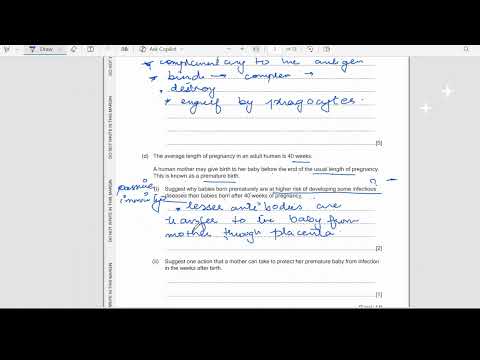
Others mark the pathogens (clump them together) so they are engulfed by phagocytes and destroyed. [1]
(d)(i)
A premature baby has had less time before birth.
It has received fewer antibodies. [1]
Antibodies pass across the placenta from the mother, and there was less time for this. [1]
(d)(ii)
Write: breast feeding (gives antibodies in the milk), or vaccinate the child. [1]
Official mark scheme

 ▶ Whole paper
Video solution of the whole paper · by Learn with Miss Sehrish. Tap the picture to open it on YouTube.
Solutions follow the official Cambridge mark schemes; marks are shown in grey. Videos are from other YouTube channels. Paper codes read component / series / year: M/J = May/June, O/N = October/November. Past-paper questions © UCLES, reproduced for classroom practice.