Q8 · 5070/22/O/N/23 Q2
Worked solution from the Metals Theory (Paper 2) booklet, Part 3 of 4.

Worked solution
(a)
Compare a transition element with a Group I metal. Transition metals are denser and harder to melt.
Write higher density (sodium has a lower density). [1]
Write higher melting point (sodium has a lower melting point). [1]
(b)
The bottom number 24 is the proton number. The top number 53 is the nucleon number.
Protons: 24 [1]
Neutrons: 53 − 24 = 29 [1]
(c)
Write the formulae: Cr2O3 + C + Cl2 → CrCl3 + CO. Correct formulae. [1]
Balance chromium: 2CrCl3. That needs 6 Cl, so 3Cl2. Oxygen: 3 O in Cr2O3, so 3CO. That needs 3C.
Cr2O3 + 3C + 3Cl2 → 2CrCl3 + 3CO. Correctly balanced. [1]
(d)
A sodium atom has 11 electrons (2,8,1). The ion loses its outer electron, so it has 10 electrons.
Draw 8 electrons in the outer shell and 2 in the inner shell (2,8). [1]
Write 1+ (or +1) on the answer line. [1]
(e)
The more easily a metal reacts with oxygen, the more reactive it is.
Write: mercury < nickel < lanthanum < sodium [1]
(f)(i)
Aluminium forms an oxide layer on its surface. [1]
This layer stops oxygen, water or acid getting in to the metal underneath (it is impermeable). [1]
(f)(ii)
Write high electrical conductivity. [1]
Write low density. [1]
Official mark scheme

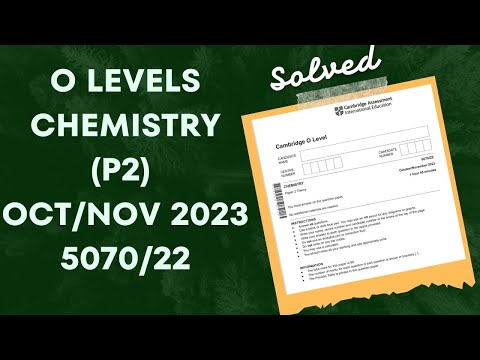 ▶ Whole paper
Video solution of the whole paper · by Sir Rehan. Tap the picture to open it on YouTube.
Solutions follow the official Cambridge mark schemes; marks are shown in grey. Videos are from other YouTube channels. Paper codes read component / series / year: M/J = May/June, O/N = October/November. Past-paper questions © UCLES, reproduced for classroom practice.