Q4 · 0620/41/M/J/21 Q7
Worked solution from the Organic chemistry Theory (Paper 4) booklet, Part 1 of 7.

Worked solution
(a)
Divide each percentage by its Ar, then divide by the smallest answer.
C: 48.65 ÷ 12 = 4.05; H: 8.11 ÷ 1 = 8.11; O: 43.24 ÷ 16 = 2.70 [1]
Divide by the smallest (2.70): C = 1.5, H = 3, O = 1 [1]
Multiply by 2 to get whole numbers: 3 : 6 : 2. Empirical formula = C3H6O2 [1]
(b)
CH4O has Mr = 12 + 4 + 16 = 32, which is the same as the given Mr. So the molecular formula is the same.
Write: CH4O. [1]
(c)(i)
Carboxylic acids with one COOH: C2H4O2, C4H8O2. The H is twice the C.
Write: CnH2nO2 (or CnH2n+1COOH). [1]
(c)(ii)
Y has 4 carbons, so it is butanoic acid.
Draw the carboxylic acid group fully: –C(=O)–O–H. [1]
Draw the whole molecule: CH3–CH2–CH2–C(=O)–O–H, with all atoms and bonds shown. [1]
name: butanoic acid [1]
(c)(iii)
Write: homologous series. [1]
(d)(i)
from brown to colourless [1]
(d)(ii)
Balance carbon and hydrogen. Two propene molecules use C6H12, leaving C9H20.
15 − 6 = 9 carbons and 32 − 12 = 20 hydrogens
Write: C15H32 → C9H20 + 2C3H6. The alkane and the propene with the 2 in front. [2]
(d)(iii)
Write: addition (polymerisation). [1]
(d)(iv)
Each propene unit has one CH3 and one H on the carbon pair. The CH3 groups point up on the first and third carbons, and H goes under.
Draw one correct repeat unit: a C with CH3 above and H below, joined to a C with H above and H below. [1]
Draw both repeat units correctly: carbons 1 and 3 have CH3 above and H below, carbons 2 and 4 have H above and H below, and the end bonds continue. [1]
Official mark scheme

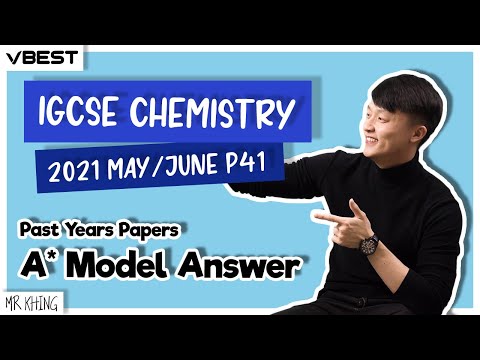 ▶ Starts at Q7 (25:23)
Starts at Q7 (25:23) · by Mr Khing. Tap the picture to open it on YouTube.
Solutions follow the official Cambridge mark schemes; marks are shown in grey. Videos are from other YouTube channels. Paper codes read component / series / year: M/J = May/June, O/N = October/November. Past-paper questions © UCLES, reproduced for classroom practice.