Q28 · 9700/43/M/J/25 Q7
Worked solution from the Photosynthesis Theory (Paper 4) booklet, Part 1 of 2.

Worked solution
(a)(i)
Rubisco is a protein, so you need the DNA that codes for it and the structure that makes proteins.
Write DNA. [1]
Write ribosome. [1]
(a)(ii)
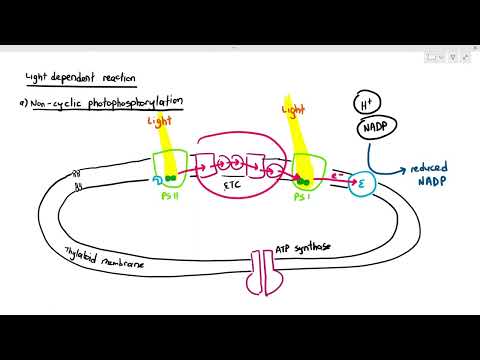
In daylight protons are pumped into the thylakoid space. Write: thylakoid space. [1]
(b)
Rf = distance moved by pigment ÷ distance moved by solvent.
First pigment: Rf = 0.73 and 6.5 ÷ 8.9 = 0.73, so the pigment is xanthophyll. [1]
Chlorophyll b distance = 0.38 × 8.9 = 3.38 = 3.4 cm [1]
Carotene Rf = 8.2 ÷ 8.9 = 0.92 [1]
(c)
Read Fig. 7.1: carotene absorbs mostly between 400 and 500 nm, with a peak near 450 nm, where chlorophyll a absorbs less.
Carotene absorbs light between 400 and 500 nm (peak at about 450 nm). [1]
It is an accessory pigment. [1]
It absorbs wavelengths that chlorophyll a (the primary pigment) does not absorb well, so it extends the range of wavelengths absorbed. [1]
It passes the energy to chlorophyll a in the reaction centre, which improves the efficiency of the light-dependent stage. [1]
Official mark scheme

 ▶ Topic lesson
A lesson on this topic · by OtterBioTutor. Tap the picture to open it on YouTube.
Solutions follow the official Cambridge mark schemes; marks are shown in grey. Videos are from other YouTube channels. Paper codes read component / series / year: M/J = May/June, O/N = October/November. Past-paper questions © UCLES, reproduced for classroom practice.