Q34 · 5090/22/O/N/24 Q3
Worked solution from the Coordination and control Theory (Paper 2) booklet, Part 6 of 6.

Worked solution
(a)
Fill the gaps in order using the list:
Glucose is carried in the blood component called plasma. [1]
The hormone released when blood glucose is high is insulin. [1]
It is released by an endocrine gland. [1]
The gland is the pancreas. [1]
Glucose is converted into glycogen. [1]
(b)(i)
The cell is round and has a dip in the middle, with no nucleus: red blood cell (erythrocyte). [1]
(b)(ii)
If red blood cells lose their shape, become stiff and stick together, then any five of these:
They have a reduced surface area. [1]
They are less able to fit through capillaries. [1]
They may cause clotting. [1]
Less oxygen is absorbed, carried or supplied to the body cells. [1]
This is because haemoglobin carries oxygen. [1]
So there is less aerobic respiration.
So less energy is released. (Any five of these points score the 5 marks.)
Official mark scheme

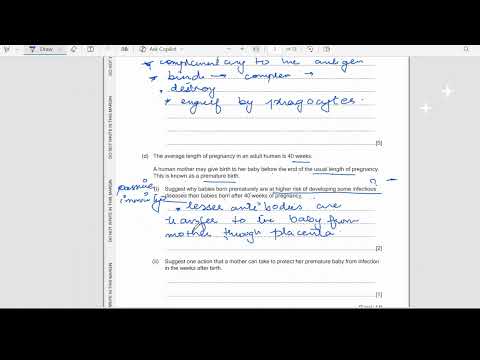 ▶ Whole paper
Video solution of the whole paper · by Learn with Miss Sehrish. Tap the picture to open it on YouTube.
Solutions follow the official Cambridge mark schemes; marks are shown in grey. Videos are from other YouTube channels. Paper codes read component / series / year: M/J = May/June, O/N = October/November. Past-paper questions © UCLES, reproduced for classroom practice.