Q22 · 9708/22/O/N/20 Q3
Worked solution from the Government macroeconomic intervention Theory (Paper 2) booklet, Part 3 of 4.

Worked solution
(a)
Explain means: say what enterprise does, then show how that adds to aggregate supply, then show how its reward differs from the other factors.
Write: enterprise organises the other factors of production (land, labour and capital) to make goods and services. [1]
Write: enterprise also bears the risk of production (costs may turn out higher than revenue). [1]
To produce, enterprise hires labour, which is rewarded with wages; [1]
it uses land (natural resources), which is rewarded with rent; [1]
and it uses capital, which is rewarded with interest. [1]
By organising these factors to produce goods and services, enterprise raises aggregate supply (total output in a given time period). [1]
Aggregate supply rises through an increase in productive potential or a fall in unused resources. [1]
The difference: the reward for enterprise is profit, which is the reward for taking risk. A loss-making firm earns no profit, but labour, land and capital are still rewarded with wages, rent and interest. [1]
(b)
Explain how AD is affected by taking at least two components of AD, then judge whether the effect falls on employment or on the price level.
Consumption: a rise in the money supply lowers interest rates, so loans become cheaper. [1]
The reward for saving is lower, so households save less. [1]
Households borrow and spend more, so consumption rises. [1]
Higher consumption means aggregate demand rises. [1]
Investment: lower interest rates make borrowing cheaper for firms. [1]
More investment projects now look profitable. [1]
Firms buy more capital goods, so investment rises. [1]
Higher investment means aggregate demand rises again. [1]
Evaluation: if the economy has spare capacity and unemployment, firms can raise output, so the effect is mainly on employment and output. [1]
If the economy is near full employment, output cannot rise much, so extra demand mainly pushes up the general price level. [1]
The outcome also depends on how far interest rates fall and how strongly households and firms respond to cheaper borrowing. [1]
Conclusion: the impact falls on employment when there is spare capacity and on the price level when the economy is close to full capacity, so the answer depends on how much spare capacity there is. [1]
Official mark scheme

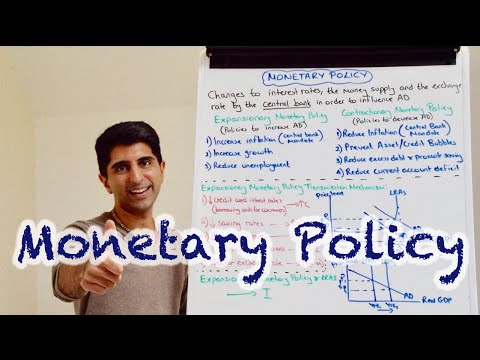 ▶ Topic lesson
A lesson on this topic · by EconplusDal. Tap the picture to open it on YouTube.
Solutions follow the official Cambridge mark schemes; marks are shown in grey. Videos are from other YouTube channels. Paper codes read component / series / year: M/J = May/June, O/N = October/November. Past-paper questions © UCLES, reproduced for classroom practice.