Q29 · 9706/41/O/N/23 Q2
Worked solution from the Cost and management accounting (A Level) Theory (Paper 4) booklet, Part 2 of 4.

Worked solution
(a)
Write: planning and control, to help achieve the predetermined targets. [1]
Write: it identifies areas of strength and weakness. [1]
(Another accepted benefit: it helps forward-looking decisions.)
(b)(i)
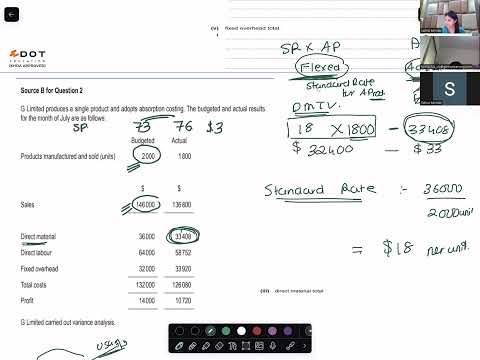
Budgeted price = $146 000 ÷ 2 000 = $73. Sales price variance = actual sales − (budgeted price × actual units)
= $136 800 − ($73 × 1 800) = $136 800 − $131 400 = $5 400 favourable [2]
(b)(ii)
Budgeted profit per unit = $14 000 ÷ 2 000 = $7. Sales volume variance = (budgeted units − actual units) × profit per unit
= (2 000 − 1 800) × $7 = $1 400 adverse [2]
(b)(iii)
Standard material cost per unit = $36 000 ÷ 2 000 = $18. Direct material total = standard cost for actual units − actual cost
= (1 800 × $18) − $33 408 = $32 400 − $33 408 = $1 008 adverse [2]
(b)(iv)
Standard labour cost per unit = $64 000 ÷ 2 000 = $32.
= (1 800 × $32) − $58 752 = $57 600 − $58 752 = $1 152 adverse [2]
(b)(v)
Standard fixed overhead per unit = $32 000 ÷ 2 000 = $16.
= (1 800 × $16) − $33 920 = $28 800 − $33 920 = $5 120 adverse [2]
(c)
The total variance is made of a rate part and an efficiency part, so calculate both.
Standard labour rate = ($64 000 ÷ 2 000) ÷ 2 hours = $16 per hour. Actual labour rate = $58 752 ÷ 3 456 = $17 per hour.
Labour rate variance = $58 752 − ($16 × 3 456) = $58 752 − $55 296 = $3 456 adverse [2]
Reason: the wage rate increased, for example demanded by a labour union, a rise in the minimum wage or inflation. [1]
Labour efficiency variance = [(2 × 1 800) − 3 456] × $16 = 144 × $16 = $2 304 favourable [2]
Reason: skilled labour, good supervision or fewer machine breakdowns meant fewer hours were used. [1]
So the total adverse variance of $1 152 is the adverse rate variance less the favourable efficiency variance ($3 456 − $2 304).
(d)
Calculations. Standard usage = 1 800 units × 3 kilos = 5 400 kilos. [1]
Actual usage = $33 408 ÷ $6.40 = 5 220 kilos. [1]
The existing supplier's price rises from $6.40 by 5% to $6.40 × 1.05 = $6.72 (the standard price is $6). This is higher than the new supplier's $6.20.
Existing supplier: usage was below standard, so the quality seems good and less material was used. [1]
If the selling price is not adjusted, profit will decrease. [1]
New supplier: the price is lower than the existing supplier's. [1]
The minimum order of 10 000 kilos means careful inventory control is needed, or extra storage and spoilage costs arise. [1]
Decision: change to the new supplier, because the lower price outweighs the risk if inventory is controlled. [1]
(Other valid comments are accepted, for example the quality or reliability of the new supplier is uncertain.)
Official mark scheme

 ▶ Whole paper
Video solution of the whole paper · by IGCSE / AS LEVEL / A LEVEL MATHS AND ACCOUNTS. Tap the picture to open it on YouTube.
Solutions follow the official Cambridge mark schemes; marks are shown in grey. Videos are from other YouTube channels. Paper codes read component / series / year: M/J = May/June, O/N = October/November. Past-paper questions © UCLES, reproduced for classroom practice.