Q3 · 9701/22/F/M/22 Q4
Worked solution from the Organic synthesis Theory (Paper 2) booklet, Part 1 of 1.

Worked solution
(a)(i)
J has a ketone group (C=O) and an aldehyde group (CHO), and also an alcohol group (OH). Think about what each reagent reacts with.
2,4-DNPH reacts with any C=O group. Write: red / orange / yellow precipitate. [1]
Tollens' reagent is oxidised by the aldehyde group. Write: silver mirror (or silver / grey solid). [1]
Sodium metal reacts with the OH group and gives off hydrogen. Write: effervescence / bubbles / fizzing. [1]
(a)(ii)
The central carbon is a chiral centre. It has four different groups: OH, CH3, CHO and COCH3.
Draw the central carbon with two bonds in the plane, one wedge and one dashed bond. Then draw the second isomer as its mirror image (swap the wedge and dashed groups).
Isomer 1: OH at the top, CH3CO on the left (plain bond), CHO on the right (dashed bond), CH3 at the bottom (wedge). [1]
Isomer 2: the mirror image, with OHC on the left (dashed), COCH3 on the right (plain) and H3C at the bottom (wedge). The two must be non-superimposable mirror images. [1]
(b)(i)
K is a carboxylic acid and M is its methyl ester. An ester forms from an acid plus an alcohol.
Write: L = CH3OH (methanol). [1]
Write: conditions = acid catalyst (H+ or H2SO4) and heat under reflux. [1]
(b)(ii)
In addition polymerisation the C=C double bond opens up and becomes a single bond. The two carbons join to the next units on each side.
Draw the two carbons joined by a single bond, with a 'dangling' bond going out of each end. [1]
Put H and CH3 on one carbon and H and COOCH3 on the other, as in M. The repeat unit is (–CH2–C(CH3)(COOCH3)–) with the groups drawn out. [1]
(b)(iii)
Compare the two molecules. M has a C=C bond, but the polymer has used it up.
Write: Perspex® would not have an absorption at 1500–1680 cm−1 because it does not contain C=C. [1]
(b)(iv)
Step 1 turns a C=O into C(OH)–C≡N. This is the addition of HCN.
Step 1 reagent: write HCN or KCN (or NaCN with H2SO4). [1]
Step 1 type of reaction: addition. [1]
Step 2 turns the nitrile (C≡N) into COOH.
Step 2 reagent: H+ / H2SO4(aq) (heated). [1]
Step 2 type of reaction: hydrolysis (substitution is also accepted). [1]
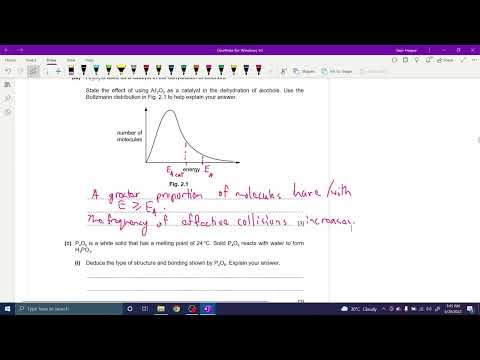
Step 3 uses Al2O3 to remove water and make a C=C bond.
Step 3 type of reaction: elimination (or dehydration). [1]
Official mark scheme

 ▶ Whole paper
Video solution of the whole paper · by CAIE PAPERS SOLVED. Tap the picture to open it on YouTube.
Solutions follow the official Cambridge mark schemes; marks are shown in grey. Videos are from other YouTube channels. Paper codes read component / series / year: M/J = May/June, O/N = October/November. Past-paper questions © UCLES, reproduced for classroom practice.