Q3 · 9700/41/M/J/20 Q9
Worked solution from the Genetic technology Theory (Paper 4) booklet, Part 1 of 3.

Worked solution
(a)
Describe the three PCR steps, then say they repeat. Any eight points:
DNA is denatured to single strands by heating to 94 to 95 °C. [1]
Primers are added, and bind by complementary base pairing. [1]
This is annealing, at 55 to 65 °C. [1]
DNA polymerase builds new strands by adding free nucleotides. [1]
This happens at 70 to 75 °C. [1]
Taq polymerase is thermostable, so it does not need replacing. [1]
The new strands are denatured and the process is repeated, doubling the DNA each cycle. [1]
The process is automated. [1]
(b)
Explain why recombinant human proteins are better. Any seven points:
Large quantities can be made. [1]
A bacterial / hamster cell / insect larva cell host is used. [1]
The product is exactly the same as the human protein, with the same amino acid sequence. [1]
There is no immune response. [1]
There are no side effects. [1]
There is no risk of transfer of disease. [1]
It is easier to obtain a purified product. [1]
Official mark scheme

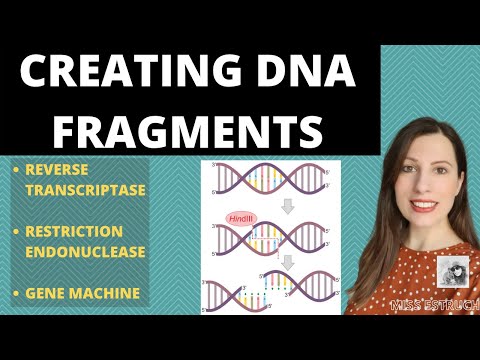 ▶ Topic lesson
A lesson on this topic · by Miss Estruch Biology. Tap the picture to open it on YouTube.
Solutions follow the official Cambridge mark schemes; marks are shown in grey. Videos are from other YouTube channels. Paper codes read component / series / year: M/J = May/June, O/N = October/November. Past-paper questions © UCLES, reproduced for classroom practice.