Q45 · 9708/23/M/J/22 Q4
Worked solution from the International economic issues Theory (Paper 2) booklet, Part 5 of 5.

Worked solution
(a)
The current account measures trade in goods and services, plus other income. [1]
A deficit means the money paid out by the country (for example on imports) is greater than the money received (for example from exports). [1]
Causes of a deficit: an appreciation of the exchange rate makes exports dearer and imports cheaper, so fewer exports and more imports. [1]
A fall in the supply of primary goods for export, or a deterioration in the terms of trade, reduces export earnings. [1]
A fall in aid, a fall in transfers from migrant workers overseas, or increased protection by trading partners can also widen the deficit. [1]
Why it is persistent: the causes are long-lasting. For example, a country that depends on primary goods for exports keeps low export earnings if their supply is reduced or its terms of trade stay poor. [1]
If the exchange rate stays high, or trading partners keep up their protection, exports stay hard to sell while imports stay cheap. [1]
Without more exports or less import demand, the causes remain, so the deficit keeps repeating year after year. [1]
(b)
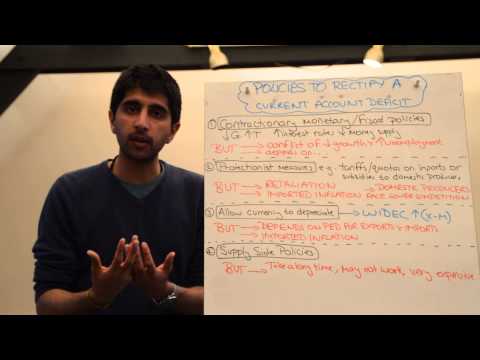
Expenditure-switching policies encourage people to switch from imports to domestic goods (protectionism, supply-side and exchange rate policies). Expenditure-reducing policies reduce domestic AD (higher taxes, lower government spending) to cut imports.
Advantages of expenditure-switching policies: tariffs, quotas or a lower exchange rate make imports dearer and exports cheaper, so demand shifts to domestic goods without cutting total demand. [1]
Supply-side policies make firms more competitive over time, which helps exports and cuts imports in the long term. [1]
Disadvantages of expenditure-switching policies: protectionism may lead to retaliation and is weak if demand for imports is price-inelastic; a lower exchange rate may cause imported inflation. [1]
Supply-side policies take a long time to work and cost money. [1]
Advantages of expenditure-reducing policies: raising taxes or cutting government spending lowers incomes, so demand for imports falls and more goods are available for export. [1]
They also reduce inflation, making exports more price competitive. [1]
Disadvantages of expenditure-reducing policies: lower AD means lower output, slower growth and higher unemployment. [1]
They can be politically unpopular, and if the deficit is caused by supply-side weakness they do not fix the cause. [1]
Evaluation: compare them. Expenditure-reducing policies may work quickly but have high costs for growth and jobs; expenditure-switching policies are less damaging to output but may be slower and less certain. [1]
The extent to which each works depends on the size and cause of the deficit, the PED of imports and exports, and the time period. [2]
Conclusion: expenditure-switching policies, especially supply-side policies, are more likely to reduce a deficit over time without harming the economy, though a mix of the two may be needed. [1]
Official mark scheme

 ▶ Topic lesson
A lesson on this topic · by EconplusDal. Tap the picture to open it on YouTube.
Solutions follow the official Cambridge mark schemes; marks are shown in grey. Videos are from other YouTube channels. Paper codes read component / series / year: M/J = May/June, O/N = October/November. Past-paper questions © UCLES, reproduced for classroom practice.