Q61 · 9609/22/M/J/21 Q1
Worked solution from the Marketing Theory (Paper 2) booklet, Part 3 of 3.

Worked solution
(a)(i)
Write: a service is an intangible product (something a customer cannot touch). [1]
It is sold by a business and paid for by customers (a process or action done for them). [1]
(a)(ii)
Explain means: say what it is and add the key features.
A sole trader is a business owned by one person (one individual). [1]
The owner has unlimited liability, so personal assets are at risk if the business fails. [1]
The business has no shareholders and does not need to publish financial accounts. [1]
(b)(i)
Share of market (%) = HB's number of customers ÷ total market size × 100
Total market for laundry services = 20% of 60 000 households = 12 000 households [1]
HB's customers = 300 households [1]
= 300 ÷ 12 000 × 100 [1]
= 2.5% [1]
(b)(ii)
Analyse means: name the factor, apply it to HB, then follow the chain of cause and effect. Factors affecting scale are about the business's ability to supply, not the market's demand.
Factor 1: capital (machinery). Karen is a sole trader and owns only two washing machines, two drying machines and one iron. Each batch takes about two hours to wash, dry and iron, so there is a limit to how much laundry she can process each day. This limits the scale of HB: HB cannot take on many more customers, so revenue and profit stay low. Buying more machines would raise the scale, but a sole trader has limited finance to pay for them.
Factor 2: labour. Karen works alone and uses the morning for collections and the evening for deliveries. The quantity of the workforce limits how much HB can do. If Karen employs someone to do collections and deliveries, she has more time for washing, so HB can serve more households. The scale increases, which can raise revenue and profit, though wages add to costs.
(Other factors also credited: Karen as the entrepreneur willing to take risks, or the van and the amount of laundry it can carry.)
This earns the top band for knowledge and application: two factors that affect scale, each applied to HB. [4]
This earns the top band for analysis: good analysis of two factors, each developed to the effect on HB's scale, revenue, costs and profit. [4]
(c)
Explain means: name the method and say why it suits Karen.
Recruitment through a local online jobs website or a job advertisement (external recruitment). [1]
It suits Karen because the job is collections and deliveries around town P, needs no special qualifications (maybe a driving licence) and HB is a small sole trader with no other workers, so a cheap, local advert will reach people who know the local area. [1]
(d)
Evaluate means: weigh up the methods for this market and reach a judgement.
Knowledge: promotion methods include personal selling and direct marketing, among others. HB is a small sole trader with limited finance, and the hotels are a B2B market. Table 1.1 shows 14 hotels in town P and 45 within 30 miles, and 50% have their own laundry service, so roughly 7 in town P and about 22 or 23 within 30 miles (about 29 or 30 in all) could be customers.
Personal selling: Karen could visit the hotels that do not have their own laundry. She can explain the advantages of her service and answer the managers' questions. It is a sensible approach with limited cost for a small business, and it could make hotels more willing to use HB. She could also hire a salesperson on commission only.
Direct marketing: Karen could send details of her service to the 14 hotels in town P. It is low cost because there are only 14 hotels, it can be done with a limited budget and it stays under Karen's control. But it may be seen as junk mail and ignored, so HB may gain no new customers.
Other methods: local advertising in hotel trade publications or local radio would be appropriate for the hotel industry. Sponsorship is unlikely to be targeted enough. Sales promotion (such as a discount or a buy-one-get-one-free offer) is unlikely to win the hotel market alone, but with informative methods it may help HB penetrate this new market.
Evaluation: personal selling is likely to be the most appropriate method, better than direct mail, because Karen can explain HB's unique selling point and try to convince hotel managers face to face, and it costs little. However, this depends on whether Karen is a good salesperson. If she is not, it could waste her time and money. A combination of personal selling with a cheap sales promotion may be the best way into the hotel market.
This earns the top band for knowledge and application: two promotion methods, each applied to HB and the hotel market. [4]
It reaches the top level for analysis and evaluation: justified evaluation based on arguments in context (personal selling judged best, with reasons, and what the choice depends on). [7]
Official mark scheme

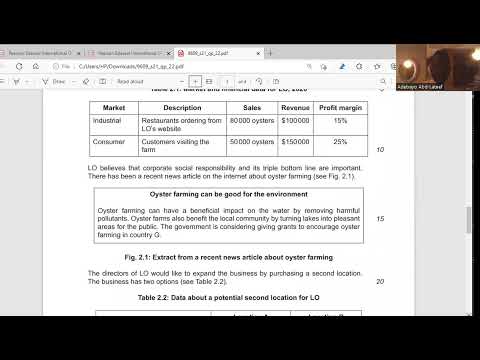 ▶ Whole paper
Video solution of the whole paper · by Adebayo Business 👨💼 Tutor (ABT). Tap the picture to open it on YouTube.
Solutions follow the official Cambridge mark schemes; marks are shown in grey. Videos are from other YouTube channels. Paper codes read component / series / year: M/J = May/June, O/N = October/November. Past-paper questions © UCLES, reproduced for classroom practice.