Q5 · 9701/22/M/J/23 Q1
Worked solution from the States of matter Theory (Paper 2) booklet, Part 2 of 2.

Worked solution
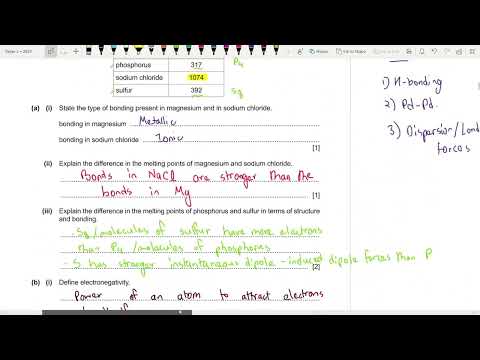
(a)(i)
Magnesium is a metal and sodium chloride is a metal and non-metal compound.
Write metallic for magnesium and ionic for sodium chloride. [1]
(a)(ii)
NaCl melts higher (1074 K) than Mg (923 K).
Write that the ionic bonds in NaCl are stronger than the metallic bonds in Mg. [1]
(a)(iii)
Phosphorus is P4 and sulfur is S8. Both are simple molecules, so the difference is in the weak forces between molecules.
S8 molecules have more electrons than P4 molecules. [1]
So sulfur has stronger instantaneous dipole–induced dipole forces, and needs more energy to melt. [1]
(b)(i)
Electronegativity is the power of an atom to attract electrons to itself (in a covalent bond). [1]
(b)(ii)
Write about the nucleus, shielding and attraction. Two correct points score 1, three score 2.
Across a period the nuclear charge increases.
The shielding is similar (same number of shells).
So the bonding electrons are attracted more strongly to the nucleus. [2]
(b)(iii)
N is small and highly electronegative and NH3 has N–H bonds.
The strongest force is the hydrogen bond. [1]
(b)(iv)
Draw two NH3 molecules, each with N at the centre of three H atoms and a lone pair on N.
Add partial charges: δ− on N and δ+ on H in both molecules (at least three correct). [1]
Draw a dashed line from the lone pair on N of one molecule to an H of the other molecule, for example δ−N–Hδ+ ··· δ−N. [1]
(b)(v)
Compare water with ammonia.
Oxygen is more electronegative than nitrogen, so the hydrogen bonds in ice are stronger. [1]
Each water molecule can form two hydrogen bonds, but each ammonia molecule only one (water has two lone pairs and two H, ammonia has one lone pair). [1]
Official mark scheme

 ▶ Whole paper
Video solution of the whole paper · by CAIE PAPERS SOLVED. Tap the picture to open it on YouTube.
Solutions follow the official Cambridge mark schemes; marks are shown in grey. Videos are from other YouTube channels. Paper codes read component / series / year: M/J = May/June, O/N = October/November. Past-paper questions © UCLES, reproduced for classroom practice.