Q40 · 9708/22/F/M/21 Q2
Worked solution from the Government macroeconomic intervention Theory (Paper 2) booklet, Part 4 of 4.

Worked solution
(a)
(i) Increased use of existing labour.
Draw a PPC diagram. Label the axes with the two types of goods (for example capital goods up and consumer goods along) and draw a bowed-out PPC. [1]
Mark a point A inside the curve, then show a movement to a point B on or nearer the PPC. [1]
The labour was unemployed or not fully used, so point A was inside the curve. Using more of it improves the use of resources and unemployment falls. [1]
Total output rises as the economy moves closer to the PPC, but the PPC itself does not move, because productive potential has not changed. [1]
(ii) Increased availability of natural resources.
Draw a second PPC diagram with the same labelled axes. [1]
Show the whole PPC shifting outwards (from PPC to PPC1). [1]
The economy now has more natural resources to produce with, so the maximum possible output of both goods rises. [1]
This increases potential output, and actual output is likely to rise as well. [1]
(b)
Discuss means: look at policies to increase the supply of labour, look at policies to increase the supply of entrepreneurship, then judge which is likely to be more successful.
Supply of labour, measure 1: training helps people enter the labour force, so more people are available for work. [1]
Supply of labour, measure 2: cutting income taxes raises the reward for working, so more people choose to work, and/or raising the retirement age or relaxing immigration controls adds to the labour force. [1]
These policies raise the number of workers and therefore the economy's productive potential. [2]
Supply of entrepreneurship, measure 1: training in management skills gives people the skills to run firms. [1]
Supply of entrepreneurship, measure 2: lower business taxes, subsidies or start-up grants raise the reward for taking risk and cut the cost of starting a firm, so more people set up businesses. [1]
These policies raise the number of firms and the amount of enterprise, which raises output. [2]
Evaluation: labour-supply policies can give quicker, larger and more certain results, because the number of people entering work is easier to raise and measure. [1]
Entrepreneurship policies can be less successful, because they rely on people being willing to take risks, which is harder to change; but each new firm can create jobs and growth. [1]
Success also depends on how large the policy is and whether people respond to the incentives. [1]
Conclusion: policies to increase the supply of labour are likely to be more successful, but they work best alongside policies for entrepreneurship, which creates the jobs. [1]
Official mark scheme

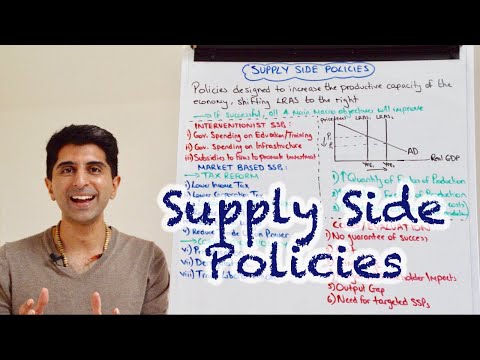 ▶ Topic lesson
A lesson on this topic · by EconplusDal. Tap the picture to open it on YouTube.
Solutions follow the official Cambridge mark schemes; marks are shown in grey. Videos are from other YouTube channels. Paper codes read component / series / year: M/J = May/June, O/N = October/November. Past-paper questions © UCLES, reproduced for classroom practice.