Q29 · 0455/22/O/N/21 Q4
Worked solution from the International trade and globalisation Theory (Paper 2) booklet, Part 3 of 4.

Worked solution
(a)
Write two of the three resource allocation decisions:
What to produce [1]
How to produce (or who to produce for) [1]
(b)
Explain means: state the reason, then say why. Give two.
Reason 1: a fall in the rate of interest. [1]
This reduces the return from saving, so households spend or borrow instead. [1]
Reason 2: an increase in taxes. [1]
This reduces disposable income, so less is left to save. [1]
(Other accepted pairs: inflation → spend before prices rise; more confidence about the future; fewer safe places to save; more consumption opportunities; bigger family; more debt; change in social attitudes.)
(c)
Analyse means: give each step of the chain of reasoning and link them.
A trade union may negotiate with employers through collective bargaining [1]
to raise wages [1]
and improve working conditions. [1]
It may also win fringe benefits, and use industrial action / strikes if talks fail. [1]
It may settle disputes and protect workers' rights. [1]
It may protect the employment of members, for example by negotiating favourable redundancy terms. [1]
(d)
Discuss means: explain why it might, explain why it might not, then decide.
Why it might: export prices fall and import prices rise, so demand for exports may rise and demand for imports may fall. [1]
Domestic output increases, so economic growth may rise, and more workers may be employed, reducing unemployment. [1]
A current account deficit may be reduced, or a surplus increased. [1]
It may encourage foreign investment if assets can be bought more cheaply. [1]
Why it might not: dearer imported capital goods and raw materials raise costs, causing cost-push inflation. [1]
Higher total demand may cause demand-pull inflation, especially near full capacity. [1]
If demand for exports and imports is price-inelastic, export revenue may fall and import spending rise; trade restrictions by other countries may also stop exports rising. [1]
Conclusion: it depends on the price elasticity of demand for exports and imports and on how close the economy is to full capacity. It helps most when demand is elastic and there is spare capacity. [1]
Official mark scheme

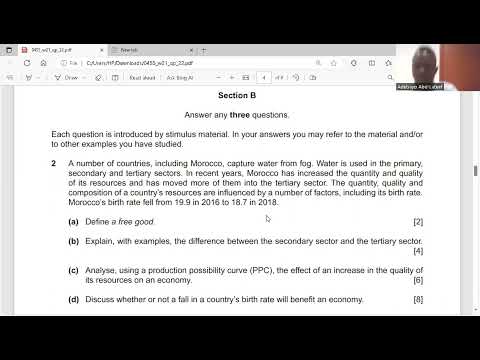 ▶ Whole paper
Video solution of the whole paper · by Adebayo Business 👨💼 Tutor (ABT). Tap the picture to open it on YouTube.
Solutions follow the official Cambridge mark schemes; marks are shown in grey. Videos are from other YouTube channels. Paper codes read component / series / year: M/J = May/June, O/N = October/November. Past-paper questions © UCLES, reproduced for classroom practice.