Q7 · 2059/21/O/N/21 Q3
Worked solution from the Agricultural development Theory (Paper 2) booklet, Part 3 of 3.

Worked solution
(a)(i)
Over 50% (the dotted-dark area) is shown on the map. Write any three points:
The distribution is uneven. [1]
It is in three areas, mostly in the north-east. [1]
It is in the east, close to India, with none in the west or near the Arabian Sea. [1]
(a)(ii)
Cultivation is to prepare land and grow crops on it. [1]
(b)(i)
Draw a line from the centre to the edge of the pie at 85% (the blank part runs from 60% to 100%). (A line at 75% also works, with the shadings the other way round.) [1]
Shade 60%-85% (cotton, 25%) with diagonal lines and 85%-100% (rice, 15%) with the rice dots from the key. [1]
(b)(ii)
Write two reasons:
It is a staple food, the main part of the local diet, with many uses (bread, roti). [1]
It has a short growing season of 90-120 days and needs less water than other crops (it suits the climate and soils). [1]
(c)(i)
Write the words in the spaces, in order:
large and commercial [1]
Sindh and subsistence [1]
northern and terraced [1]
(c)(ii)
Write any four steps:
Rice seeds are sown in beds (nurseries). [1]
Bunds and terraces are repaired, so water stays in the field, and the fields are ploughed. [1]
The fields are flooded with water from rivers or irrigation canals. [1]
When the plants are big enough, they are planted in the fields, and manure or fertiliser is added; the fields stay flooded until the rice is ripe, then the water is drained. [1]
(c)(iii)
Write two natural factors, each with its development:
Temperature: rice needs a mean temperature of 20-30 °C, warm and hot. [1]
Cold temperatures would harm the crop, and a dry, sunny period is needed for harvesting. [1]
Rainfall: rice needs heavy rainfall, at least 1270 mm. [1]
Heavy rain close to harvest time can destroy the crop. [1]
(d)
Climate challenges: increased temperatures reduce crop quantity and quality because the growing period is shorter, for example wheat or maize. There is more risk of drought and storms. Seasons are changing, so the monsoon may come late, early or be unreliable, and farmers can no longer rely on the rain. Climate change cannot be prevented, and it is expensive to deal with its effects. Drier areas also bring locusts that eat crops.
Other threats: waterlogging and salinity, traditional farming techniques with slow manual labour, little investment in machinery, seeds and training, and land fragmentation, which stops mechanisation. Most farming is subsistence, with low yields. Low literacy means farmers may lack knowledge to improve yields, and overgrazing causes soil erosion.
Judgement: climate challenges are a very big threat, but not the biggest, because they are hard to control. Many of the other threats can be solved with investment and training, so I agree only to some extent.
This reaches Level 3: it gives developed points on both views with evaluation and examples (wheat, maize, locusts), ending with a supported judgement. [6]
Official mark scheme

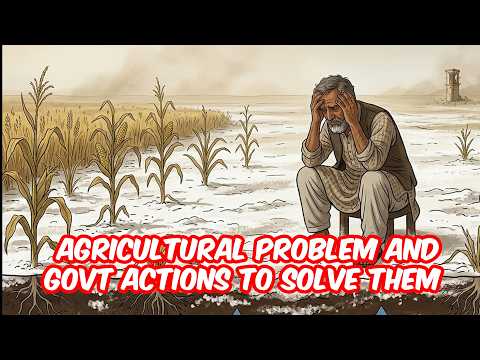 ▶ Topic lesson
A lesson on this topic · by Sir Zain Ali 2059. Tap the picture to open it on YouTube.
Solutions follow the official Cambridge mark schemes; marks are shown in grey. Videos are from other YouTube channels. Paper codes read component / series / year: M/J = May/June, O/N = October/November. Past-paper questions © UCLES, reproduced for classroom practice.