Q11 · 0610/43/M/J/22 Q6
Worked solution from the Biotechnology and genetic modification Theory (Paper 4) booklet, Part 2 of 2.

Worked solution
(a)
Look at the leaves and flowers in the photograph.
Write any one of these: two cotyledons, leaves with branching veins, broad leaves, petals in multiples of five, petioles. [1]
(b)
An enzyme is a protein [1]
that acts as a biological catalyst (it speeds up a reaction and is not changed). [1]
(c)(i)
Juice is released when cell walls break down. Write: pectinase [1]
(c)(ii)
On Fig. 6.2 the volume of juice rises to 8.4 cm3 and then stays level. The line first levels off at 45 minutes.
Write: 45 minutes [1]
(c)(iii)
Write: vitamin C (ascorbic acid) [1]
(d)(i)
Write: genetic engineering (genetic modification) [1]
(d)(ii)
Write any three disadvantages of GM plants.
Reduced biodiversity (natural populations decline). [1]
GM genes may cross-pollinate into wild populations, or insect-resistant plants may harm pollinators. [1]
GM seeds are expensive and must be bought each season. [1]
Other accepted points: ethical concerns of consumers.
Official mark scheme

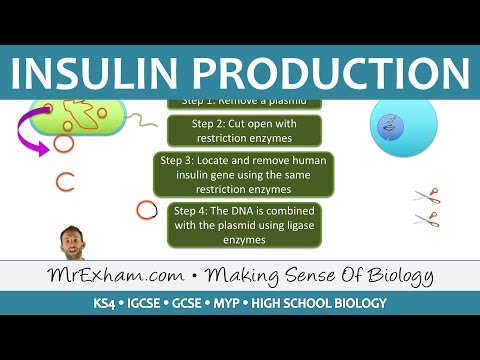 ▶ Topic lesson
A lesson on this topic · by Mr Exham Biology. Tap the picture to open it on YouTube.
Solutions follow the official Cambridge mark schemes; marks are shown in grey. Videos are from other YouTube channels. Paper codes read component / series / year: M/J = May/June, O/N = October/November. Past-paper questions © UCLES, reproduced for classroom practice.