Q3 · 9701/42/O/N/20 Q1
Worked solution from the Reaction kinetics Theory (Paper 4) booklet, Part 1 of 2.

Worked solution
(a)(i)
Write: so the concentration of I2 stays constant (does not change), so only [H2] affects the rate. [1]
(a)(ii)
For first order, the half-life is constant.
From the graph, read the time for [H2] to fall from 8 to 4: about 45 s. Then from 4 to 2: about 45 s to about 95 s, which is 50 s again. (Show these two readings on the graph.) [1]
Write: both half-lives are about 50 s (anywhere 45–55 s), so the half-life is constant, so the reaction is first order. [1]
(b)(i)
Compare two rows of the table.
Write: the order with respect to I2 is first order. [1]
Experiments 1 and 2: both concentrations rise ×10 and the rate rises ×100 (2.0 × 10⁻¹⁷ → 2.0 × 10⁻¹⁵). Since H2 is first order, its ×10 gives ×10 on the rate. [1]
So I2 must also give ×10 when its concentration goes ×10, which means first order. [1]
(b)(ii)
Write rate = k[H2][I2] [1]
(b)(iii)
Rearrange: k = rate ÷ ([H2][I2]).
k = 2.0 × 10⁻¹⁷ ÷ (1.0 × 10−2 × 1.0 × 10−2) = 2 × 10⁻¹³ [1]
Units: mol−1 dm3 s−1 [1]
(c)(i)
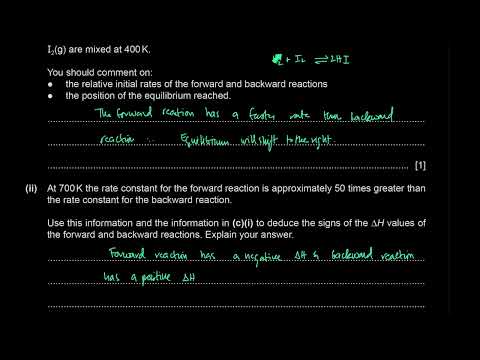
k forward is 1000 times k backward, and both reactions have the same order, so at equal concentrations the forward rate is faster.
Write: the forward reaction is faster than the backward reaction at first, and equilibrium is reached on the product side (to the right). [1]
(c)(ii)
At 700 K the ratio falls from 1000 to 50, so there is less product at higher temperature: the equilibrium moves to the left.
Write: forward ΔH is negative (exothermic) and backward ΔH is positive. [1]
Reason: the equilibrium position moves further left at higher temperature. [1]
Official mark scheme

 ▶ Whole paper
Video solution of the whole paper · by Abdullah Ghelli. Tap the picture to open it on YouTube.
Solutions follow the official Cambridge mark schemes; marks are shown in grey. Videos are from other YouTube channels. Paper codes read component / series / year: M/J = May/June, O/N = October/November. Past-paper questions © UCLES, reproduced for classroom practice.