Q15 · 9701/22/O/N/21 Q1
Worked solution from the Hydrocarbons Theory (Paper 2) booklet, Part 2 of 2.

Worked solution
(a)(i)
Boiling points rise when the forces between molecules get stronger.
Write: HI has a greater number of electrons than HCl and HBr. [1]
This gives greater induced dipoles (stronger induced dipole–dipole forces) between molecules, so more energy is needed to separate them. [1]
(a)(ii)
Draw the HF bar taller than the HI bar (anything above 240 K). [1]
Write: the hydrogen bonds between HF molecules are stronger than the induced dipoles (and permanent dipoles) in the other hydrogen halides. [1]
(b)
Write: the enthalpy change when one mole of a compound is formed [1] from its elements in their standard states. [1]
(c)(i)
Kp = (partial pressure of products)coefficient ÷ (partial pressures of reactants).
Kp = p(HI)2 ÷ [p(H2) × p(I2)] [1]
(c)(ii)
Kp = 48002 ÷ (895 × 895)
= 23 040 000 ÷ 801 025
= 28.8 (no units, as Pa cancels). [1]
(c)(iii)
The given ΔHf of HI is positive, so the forward reaction is endothermic. A lower temperature favours the exothermic (backward) direction.
Write: Kp decreases because the forward reaction is endothermic. [1]
Write: the equilibrium shifts left, so the yield (partial pressure) of HI falls. [1]
(If you use bond energy data from the Data Booklet, the reaction is really exothermic. Then you may write that Kp increases and the equilibrium shifts right, for the same 2 marks.)
(d)(i)
Write 4HI + O2 → 2I2 + 2H2O [1]
(d)(ii)
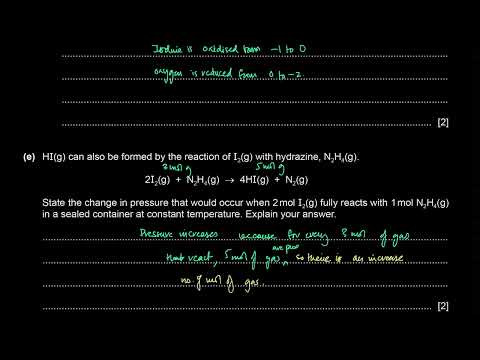
Iodine goes from −1 in HI to 0 in I2. Its oxidation number increases, so it is oxidised. [1]
Oxygen goes from 0 in O2 to −2 in H2O. Its oxidation number decreases, so it is reduced. [1]
(e)
Count gas moles: 2 + 1 = 3 on the left, 4 + 1 = 5 on the right.
Write: the pressure increases. [1]
Reason: the number of moles of gas increases from 3 to 5, and at constant temperature and volume pressure is proportional to moles. [1]
(f)(i)
Phosphorus has 5 outer electrons and each iodine has 7. P forms three single bonds and keeps one lone pair.
Draw P in the middle with three shared pairs (one dot and one cross each) to three I atoms. [1]
Show one lone pair on P and three lone pairs on each I, so each atom has the right number of outer electrons. [1]
(f)(ii)
Write hydrolysis. [1]
(f)(iii)
Write: a strong Brønsted–Lowry acid is a proton (H+) donor [1] that fully dissociates (ionises) in water. [1]
(f)(iv)
The conjugate base is the acid minus one H+.
Write H2PO3−. [1]
(g)(i)
Write: 2-iodopropane is the major product, because it forms from the more stable secondary carbocation. [1]
This carbocation is more stable because of the greater positive inductive effect of two alkyl (methyl) groups. [1]
(g)(ii)
Step 1: draw a curly arrow from the C=C double bond to the H of H–I, and a curly arrow from the H–I bond to I. [1]
Draw the intermediate CH3C+HCH3 (a secondary carbocation). Step 2: draw a curly arrow from a lone pair on I− to C+. [1]
Make sure the carbocation you drew is correct, and draw the product 2-iodopropane, CH3CHICH3. [1]
Official mark scheme

 ▶ Whole paper
Video solution of the whole paper · by Abdullah Ghelli. Tap the picture to open it on YouTube.
Solutions follow the official Cambridge mark schemes; marks are shown in grey. Videos are from other YouTube channels. Paper codes read component / series / year: M/J = May/June, O/N = October/November. Past-paper questions © UCLES, reproduced for classroom practice.