Q13 · 9700/43/M/J/22 Q2
Worked solution from the Photosynthesis Theory (Paper 4) booklet, Part 1 of 2.

Worked solution
(a)(i)
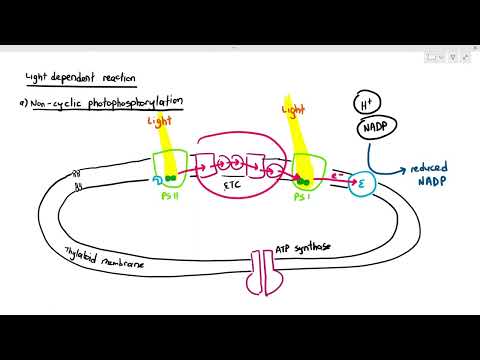
Write similarities and differences. Any four score.
Similarity: both use light to excite electrons in chlorophyll (photoactivation). [1]
Similarity: both involve an electron transport chain. [1]
Similarity: both make ATP. [1]
Difference: cyclic uses only PSI; non-cyclic uses PSI and PSII. [1]
Also credited (not needed for the four marks): Difference: cyclic makes no reduced NADP and no oxygen; non-cyclic makes reduced NADP and oxygen.
Also credited (not needed for the four marks): Difference: cyclic has no photolysis; non-cyclic has photolysis of water.
Also credited (not needed for the four marks): Difference: in cyclic the electrons return to PSI; in non-cyclic electrons from PSII are replaced by water.
(a)(ii)
Without these pathways there is no ATP or reduced NADP. Any two score.
No ATP and no reduced NADP are made. [1]
So GP cannot be reduced to TP and RuBP is not regenerated, so the Calvin cycle stops and no carbohydrate is made. [1]
(b)(i)
Read Fig. 2.1 for the wild type (solid line).
The CO2 fixation rate increases as CO2 concentration increases, for example from about 1 µmol CO2 m−2 s−1 at about 50 mg m−3 to 42 µmol CO2 m−2 s−1 at about 1200 mg m−3, because CO2 is the limiting factor. [2]
Above about 1200 mg m−3 the rate levels off (plateaus) at 42 µmol CO2 m−2 s−1, because CO2 is no longer limiting; temperature, light intensity or RuBP regeneration is now the limiting factor. [2]
(b)(ii)
Compare Sox4 with the wild type. Any three score.
Sox4 has a higher rate of CO2 fixation / reaches a higher maximum rate. [1]
Quote the figures: 42 (wild type) compared with 47 (Sox4) µmol CO2 m−2 s−1. [1]
Explanation: Sox4 has more SBPase, so RuBP is regenerated faster, giving more RuBP to react with CO2 (and rubisco). [1]
Official mark scheme

 ▶ Topic lesson
A lesson on this topic · by OtterBioTutor. Tap the picture to open it on YouTube.
Solutions follow the official Cambridge mark schemes; marks are shown in grey. Videos are from other YouTube channels. Paper codes read component / series / year: M/J = May/June, O/N = October/November. Past-paper questions © UCLES, reproduced for classroom practice.