Q50 · 9708/41/M/J/22 Q2
Worked solution from the The price system and the microeconomy Theory (Paper 4) booklet, Part 6 of 8.

Worked solution
(a)
The question asks you to explain what a public good is and discuss why providing it is linked to market failure. Plan: meaning, key features, the free-rider problem, then allocative inefficiency and a conclusion.
A public good is a good with two key characteristics: it is non-rival (one person's use does not stop another using it) and non-excludable (no one can be stopped from using it once it is provided). Some also add that it is non-divisible and non-rejectable. Examples: street lighting, national defence, a lighthouse.
Because no one can be excluded, people can use the good without paying. This is the free rider problem. Firms cannot charge a price, so the free market will not provide the good, or will provide too little.
Market failure link: allocative efficiency is when resources are allocated to maximise consumer satisfaction. If public goods are not provided, consumer satisfaction is not maximised, so the market is allocatively inefficient. This is market failure.
Evaluation: unless the state provides public goods, market failure will occur. Without them, total consumer satisfaction would be lower.
Conclusion: public goods are important because people benefit from them but the market will not supply them, so the government can help to address this type of market failure by providing them.
This reaches the top level (Level 4): a reasoned, clear discussion of the key characteristics of a public good, analysis linking allocative efficiency to market failure, evaluation of the effect on consumer satisfaction, and a conclusion on the importance of public goods and the government's role. [12]
(b)
The question asks you to discuss the extent to which monopoly producers and their consumers might benefit from barriers to entry. Plan: define monopoly, choose two barriers, show good and bad effects on producer and consumer, then judge.
A monopoly producer might control all the market supply, or the state may define it legally, for example a firm with at least 25% of the market share. Barriers to entry stop new firms joining the market.
Benefits to the monopolist might include higher profits, increased efficiency, increased market share and growth of the firm. Benefits to consumers might include lower prices, a higher quality product and greater availability.
Barrier 1, economies of scale: they can raise monopoly profit by lowering unit costs, and the consumer may benefit from lower prices passed on.
Barrier 2, limit pricing (keeping price low to deter new entrants): the consumer gets lower prices in the short run, but the firm gains a higher market share and higher profits in the long run.
Other barriers include branding or advertising, legal requirements or patents, and natural monopolies. Each can have a positive or a negative effect on both the producer and the consumer.
Wider benefit: barriers let a monopolist keep profits in the long run and spend them on research and development, giving dynamic efficiency. This can reach consumers as lower prices, better quality and more choice.
Against: barriers may lead to complacency and X inefficiency, which is likely to mean higher prices and lower quality for consumers.
Conclusion: the producer almost certainly gains, while consumers gain only if cost savings and R&D are passed on; if the firm becomes complacent, consumers lose. So the net benefit depends on how the firm uses its protected position.
This reaches the top level (Level 4): a clear explanation of two barriers to entry, a discussion of how each has both a positive and a negative effect on the producer and the consumer, and an attempt to summarise the extent of the net benefit. [13]
Official mark scheme

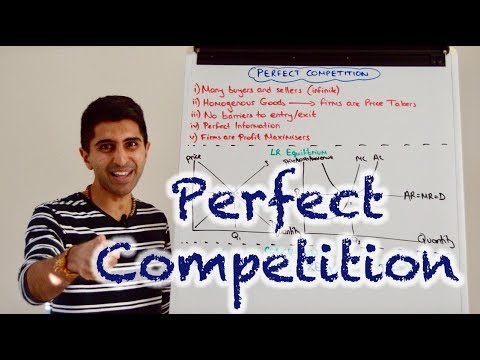 ▶ Topic lesson
A lesson on this topic · by EconplusDal. Tap the picture to open it on YouTube.
Solutions follow the official Cambridge mark schemes; marks are shown in grey. Videos are from other YouTube channels. Paper codes read component / series / year: M/J = May/June, O/N = October/November. Past-paper questions © UCLES, reproduced for classroom practice.