Q262 · 0620/23/O/N/25 Q35
Worked solution from the Organic chemistry MCQ booklet.

Worked solution
The question asks how many monomers can form a polymer with a dicarboxylic acid (HOOC–□–COOH).
Each monomer must have two groups that can react with –COOH, one at each end, so a chain can keep growing.
Diamine (H2N–□–NH2): both ends react to form amide links. ✓
Amino acid (HOOC–□–NH2): its COOH end cannot react with the other acid, so no polymer forms. ✗
Amino-alcohol (HO–□–NH2): NH2 gives an amide and OH gives an ester, so both ends react. ✓
Diol (HO–□–OH): both ends form ester links. ✓
So 3 monomers work.
So the answer is C.
A and B miss some that work. D includes the amino acid, which has a COOH group that cannot react with the diacid.
 ▶ Whole paper
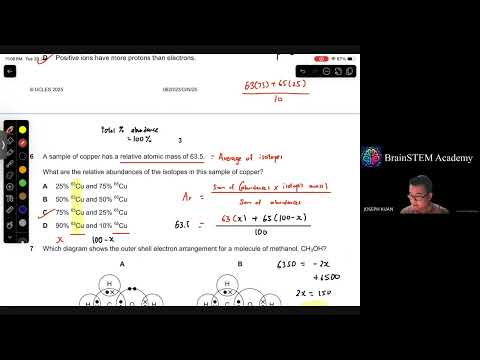
Video solution of the whole paper · by Teacher Joseph Kuan - IGCSE Chemistry Online Tutor. Tap the picture to open it on YouTube.
Solutions follow the official Cambridge mark schemes. Videos are from other YouTube channels. Paper codes read component / series / year: M/J = May/June, O/N = October/November. Past-paper questions © UCLES, reproduced for classroom practice.