Q8 · 9609/32/F/M/23 Q2
Worked solution from the Human resource management Theory (Paper 3) booklet, Part 1 of 4.

Worked solution
(a)
Write about benefits to FWB only. Take two benefits and develop each in a chain.
Knowledge: delegation is passing authority down to take decisions. Here van managers would decide things like local promotion, products and van locations.
Benefit 1: more motivated managers, lower labour turnover (knowledge). Good van managers left in 2022 and many had asked for more control (application). Delegation may motivate them and keep them, so FWB saves recruitment costs (replacing experienced managers is hard). Motivated managers may also work harder and give better customer service, which raises sales and profit (analysis).
Benefit 2: faster, more responsive local decisions (knowledge). FWB has big demographic, cultural and income differences across country K, but managers have no power over marketing (application). Managers who know their area can change promotion and products to suit local customers, so customer satisfaction and sales rise, and so does profit (analysis).
This earns the top level for knowledge: two relevant points are used to answer the question. [2]
It earns the top level for application: each point is applied to the business using the case facts above. [2]
It earns the top level for analysis: developed analysis that links causes, impacts and consequences for both points. [4]
Official mark scheme

 ▶ Whole paper
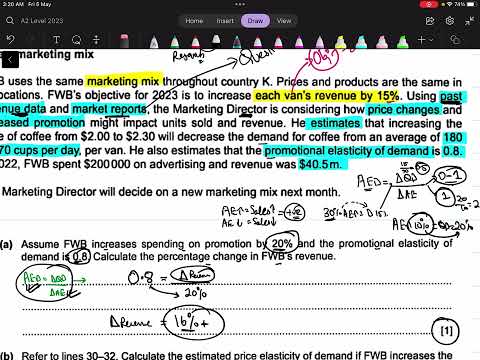
Video solution of the whole paper · by Bilal Kurd. Tap the picture to open it on YouTube.
Solutions follow the official Cambridge mark schemes; marks are shown in grey. Videos are from other YouTube channels. Paper codes read component / series / year: M/J = May/June, O/N = October/November. Past-paper questions © UCLES, reproduced for classroom practice.