Q8 · 2281/23/O/N/22 Q5
Worked solution from the International trade and globalisation Theory (Paper 2) booklet, Part 2 of 4.

Worked solution
(a)
Write any two components of the current account:
Trade in goods (visible trade) [1]
Trade in services (invisible trade) [1]
(Primary income and secondary income (current transfers) are also accepted.)
(b)
Write two reasons, each with an explanation:
Differences in income (GDP per head), [1]
which change people's ability to buy goods and services. [1]
Differences in healthcare, [1]
which cause differences in life expectancy. [1]
(Also accepted: productivity, education, technology, availability of resources, international trade, cost of living, environment, war.)
(c)
Analyse means: give each step of the chain of reasoning and link them. Use two or three reasons:
To protect infant industries, [1]
so they can gain economies of scale and are not driven out by much bigger, lower-cost foreign firms. [1]
To improve the current account: tariffs raise the price of imports, [1]
which reduces demand for imports and import spending, [1]
and raises demand for domestic firms, which cuts unemployment and can increase economic growth. [1]
To stop dumping, where goods are sold below cost price to drive out domestic firms. [1]
(d)
Discuss means: explain why it might happen, explain why it might not, then decide.
Why it might: households borrow and spend more on goods and services, [1]
so total demand rises and firms increase output. [2]
Firms may borrow to invest more, which leads to higher employment, [1]
and higher investment raises both total demand and productive capacity, so economic growth is stronger. [1]
Why it might not: the economy may already be at full employment, [1]
so higher total demand may raise prices (inflation) instead of output. [1]
People may spend the borrowed money on imports, or borrow only to repay past debts; a later rise in a variable interest rate could also cut future spending and investment. [1]
Conclusion: it depends on whether there is spare capacity and where the money is spent.
Official mark scheme

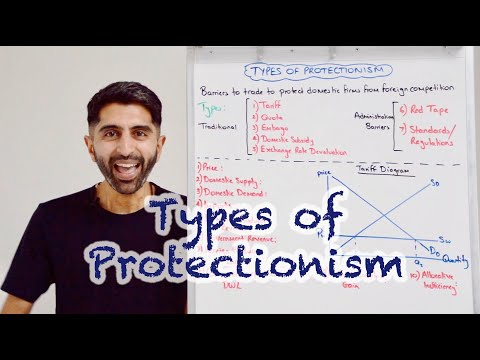 ▶ Topic lesson
A lesson on this topic · by EconplusDal. Tap the picture to open it on YouTube.
Solutions follow the official Cambridge mark schemes; marks are shown in grey. Videos are from other YouTube channels. Paper codes read component / series / year: M/J = May/June, O/N = October/November. Past-paper questions © UCLES, reproduced for classroom practice.