Q26 · 9618/13/O/N/25 Q2
Worked solution from the Information representation Paper 1 Theory Fundamentals booklet, Part 1 of 3.

Worked solution
(a)
Work out the bits needed for each:
| Example of data | Number of bits |
|---|---|
| hexadecimal F139 | 16 |
| 16 000 000 unique amplitude values | 24 |
| an IPv4 address | 32 |
| 256 unique colours | 8 |
| an IPv6 address | 128 |
| denary value 65 000 | 16 |
Tick each row in its column (F139 is 4 hex digits = 16 bits, 224 is about 16.7 million, 28 = 256, 65 000 is under 216).
All 6 rows correct earns 3 marks (4 or 5 correct earns 2, 2 or 3 correct earns 1) [3]
(b)
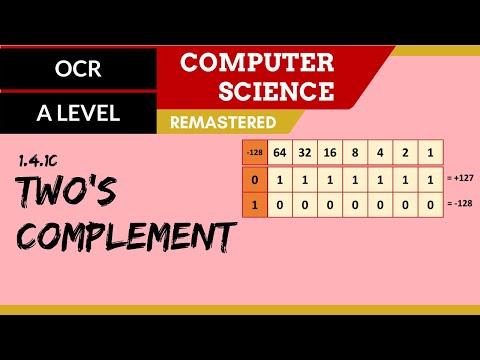
108 = 64 + 32 + 8 + 4 = 0000 0110 1100 in 12 bits.
Flip the bits: 1111 1001 0011. Add 1.
Write: 1111 1001 0100 [1]
(c)
Shift 10010011 right 3 places and copy the sign bit (1) into the left.
Write: 1111 0010 [1]
(d)
1110 = E, 0011 = 3, 0011 = 3, 1011 = B.
Write: E33B [1]
Official mark scheme

 ▶ Topic lesson
A lesson on this topic · by Craig'n'Dave. Tap the picture to open it on YouTube.
Solutions follow the official Cambridge mark schemes; marks are shown in grey. Videos are from other YouTube channels. Paper codes read component / series / year: M/J = May/June, O/N = October/November. Past-paper questions © UCLES, reproduced for classroom practice.