Q39 · 9609/32/M/J/23 Q1
Worked solution from the Marketing Theory (Paper 3) booklet, Part 2 of 2.

Worked solution
Answer
Analyse means: for each element, say what must change, apply it to OV, and follow the chain of cause and effect.
A marketing strategy has objectives, a budget and a coordinated marketing mix. Until now OV has sold direct to consumers (B2C). Selling to retailers such as supermarkets is B2B: OV would be selling to a business, which has different needs. This means some elements of the mix must change.
Element 1: price (knowledge). OV targets health-conscious consumers who pay a premium price (application). Retailers need to make an attractive profit margin on OV's products, and OV must compete with the existing yogurts on the shelves in a very competitive market. So OV would need to lower its prices or give discounts for bulk purchases (knowledge). Lower prices give the retailer a margin, so the retailer is more likely to stock OV and orders and market share should rise (analysis).
Element 2: promotion (knowledge). OV has used social media to create a buzz about its products (application). Retailers are persuaded by different methods: trade fairs, industry and supermarket magazines, brochures, email marketing and salespeople who build trust and relationships (knowledge). Decision-makers in a retailer need information that is clear and concise, so this more targeted promotion is more likely to win orders (analysis). OV may also keep consumer promotion on TV to build the brand, so that customers ask for it and the retailer wants to stock it (analysis).
This earns the top band for knowledge: two relevant elements, price and promotion, are named and explained. [2]
It earns the top band for application: each element is applied to OV (premium price and social media promotion, and selling to supermarkets). [2]
It reaches the top level for analysis: developed chains of reasoning for two points, each linking cause, effect and consequence. [4]
Official mark scheme

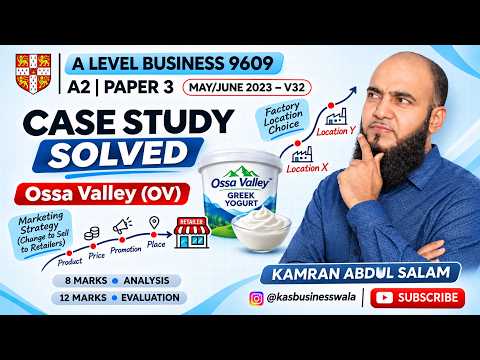 ▶ Whole paper
Video solution of the whole paper · by Kamran Abdul Salam. Tap the picture to open it on YouTube.
Solutions follow the official Cambridge mark schemes; marks are shown in grey. Videos are from other YouTube channels. Paper codes read component / series / year: M/J = May/June, O/N = October/November. Past-paper questions © UCLES, reproduced for classroom practice.