Q2 · 9706/31/O/N/20 Q5
Worked solution from the Cost and management accounting (A Level) Theory (Paper 3) booklet, Part 1 of 4.

Worked solution
(a)
Overheads are split on sales revenue. Revenue: A 2 000 × $29 = $58 000; B 3 000 × $46 = $138 000; total $196 000.
Overhead A = $58 000 ÷ $196 000 × $61 160 = $18 098; B = $138 000 ÷ $196 000 × $61 160 = $43 062
| Details | A $ | B $ |
|---|---|---|
| Sales | 58 000 | 138 000 [1] |
| Direct materials (2 000 × $8; 3 000 × $12) | 16 000 | 36 000 |
| Direct labour (2 000 × $10; 3 000 × $11) | 20 000 | 33 000 [1] |
| Overheads | 18 098 | 43 062 [2] |
| Total profit | 3 902 | 25 938 |
| Profit per unit (÷ 2 000; ÷ 3 000) | $1.95 | $8.65 [1] |
(b)
Use the cost driver for each overhead.
| Overhead | A $ | B $ |
|---|---|---|
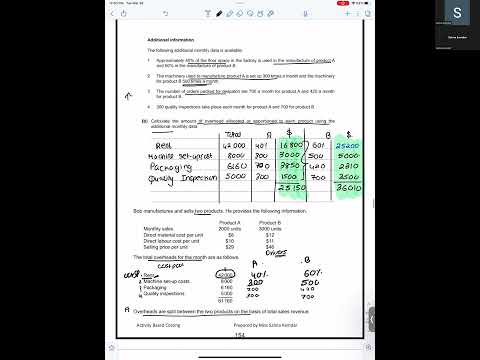
| Rent: floor space 40% and 60% of $42 000 | 16 800 | 25 200 [1] |
| Machine set-up: $8 000 ÷ 800 setups = $10 each (300; 500) | 3 000 | 5 000 [2] |
| Packaging: $6 160 ÷ 1 120 orders = $5.50 each (700; 420) | 3 850 | 2 310 [2] |
| Quality inspections: $5 000 ÷ 1 000 = $5 each (300; 700) | 1 500 | 3 500 [2] |
| Total overhead | 25 150 | 36 010 [1] |
(c)
Write: rent cannot be allocated under ABC. [1]
Because it is a fixed cost, [1]
not affected by the level of production or activity. [1]
(Also accepted: it can only be apportioned on a suitable basis such as floor area. Two reasons only are credited.)
(d)
| Details | A $ | B $ |
|---|---|---|
| Old profit | 3 902 | 25 938 |
| Add old overheads | 18 098 | 43 062 [1] |
| Less new overheads | (25 150) | (36 010) [1] |
| New profit / (loss) | (3 150) | 32 990 [1] |
| New profit / (loss) per unit (÷ 2 000; ÷ 3 000) | ($1.58) | $11.00 [1] |
(e)
Write the points (any four comments, then the decision):
The new way of sharing overheads has not changed total profit. [1]
Product A now makes a loss per unit, but it still has a positive contribution. [1]
Most of A's extra overhead is rent, which is still apportioned and so is subjective. [1]
Bob must think about what competitors charge and what the market will pay; if A's price rises, sales may fall, which could reduce total contribution while the fixed rent is still paid. [1]
Decision: Bob should not change the selling prices yet, but check the market first. [1]
Official mark scheme

 ▶ Whole paper
Video solution of the whole paper · by IGCSE / AS LEVEL / A LEVEL MATHS AND ACCOUNTS. Tap the picture to open it on YouTube.
Solutions follow the official Cambridge mark schemes; marks are shown in grey. Videos are from other YouTube channels. Paper codes read component / series / year: M/J = May/June, O/N = October/November. Past-paper questions © UCLES, reproduced for classroom practice.