Q7 · 9701/21/O/N/21 Q3
Worked solution from the The Periodic Table: chemical periodicity Theory (Paper 2) booklet, Part 2 of 3.

Worked solution
(a)(i)
White phosphorus is made of small P4 molecules. Red phosphorus is a large network.
Structure of P4: simple molecular. [1]
Structure of P: giant molecular. [1]
In P4 only weak intermolecular forces are overcome on melting, but in P strong covalent bonds must be broken. [1]
(a)(ii)
The reaction is exothermic (ΔH negative), so the products are lower in enthalpy.
Draw a curve from the P4 level up to a peak (activation energy) and down to a lower level labelled red P. [1]
(b)(i)
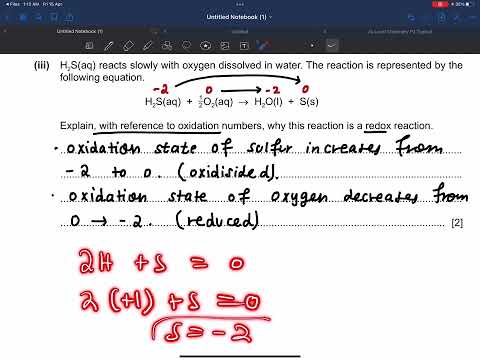
P4O10: O is −2, total −20 across 4 P, so each P is +5.
Write: (+)5. [1]
(b)(ii)
Both reactions give phosphoric(V) acid, Q = H3PO4.
Reaction 1: PCl5 + 4H2O → H3PO4 + 5HCl [1]
Reaction 2: P4O10 + 6H2O → 4H3PO4 [1]
(c)(i)
Triphenylphosphine is P(C6H5)3: 18 C, 15 H and 1 P.
Write: C18H15P. [1]
(c)(ii)
NaBH4 adds hydrogen to the aldehyde. Red P and I2 swap OH for I.
Stage 1: reduction. [1]
Stage 2: substitution. [1]
(c)(iii)
G is the alcohol from propanal. H is the alkene from joining two C3 units at C=C.
G = C2H5CH2OH (propan-1-ol) [1]
H = C2H5CH=CHC2H5 (hex-3-ene) [1]
(d)
Hot concentrated acidified MnO4− splits the C=C. A carbon with an H becomes a carboxylic acid; a carbon with two alkyl groups becomes a ketone.
Write CH3CH2CO2H (propanoic acid). [1]
Write CH3COCH3 (propanone). [1]
Official mark scheme

 ▶ Whole paper
Video solution of the whole paper · by Ahmed. Tap the picture to open it on YouTube.
Solutions follow the official Cambridge mark schemes; marks are shown in grey. Videos are from other YouTube channels. Paper codes read component / series / year: M/J = May/June, O/N = October/November. Past-paper questions © UCLES, reproduced for classroom practice.