Q13 · 0610/43/O/N/20 Q2
Worked solution from the Human nutrition Theory (Paper 4) booklet, Part 4 of 5.

Worked solution
(a)
Follow the food through the body: teeth break it up (R), amylase is secreted in the mouth (T), food moves down the oesophagus (S), nutrients are absorbed in the villi (P), then fatty acids are assimilated in the liver (Q).
Write: R, T, S, P, Q.
One mark for T before S. [1]
One mark for P before Q. [1]
(b)(i)
Write any two structures: nucleus, ribosomes, rough endoplasmic reticulum, vesicles, mitochondria, cell membrane. [2]
(b)(ii)
Choose one component, for example hydrochloric acid. [1]
It makes the optimum pH for pepsin (protease) in the stomach. [1]
It kills harmful microorganisms (it denatures their enzymes). [1]
(Another route: pepsin, which breaks protein into amino acids so they are soluble and can be absorbed; or water, which acts as a solvent.)
(b)(iii)
Goblet cells secrete mucus. [1]
(c)(i)
Fat is mixed with bile, which breaks large fat globules into smaller droplets. [1]
This increases the surface area of the fat for lipase to work on. [1]
(c)(ii)
Fats are emulsified in the small intestine (duodenum). [1]
(c)(iii)
Digested fats are absorbed into the lacteal. [1]
Official mark scheme

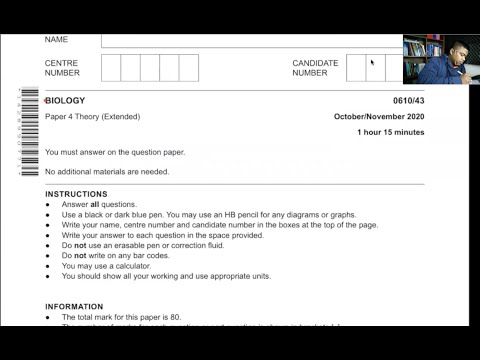 ▶ Starts at Q2 (11:13)
Starts at Q2 (11:13) · by Chemistry & Biology @ Belal Sir. Tap the picture to open it on YouTube.
Solutions follow the official Cambridge mark schemes; marks are shown in grey. Videos are from other YouTube channels. Paper codes read component / series / year: M/J = May/June, O/N = October/November. Past-paper questions © UCLES, reproduced for classroom practice.