Q51 · 9700/43/M/J/20 Q5
Worked solution from the Inheritance Theory (Paper 4) booklet, Part 3 of 3.

Worked solution
(a)(i)
Use Fig. 5.1: gene C is transcribed to make enzyme D; B is the promoter that factors bind to; A (Mig1) binds to B and stops transcription.
Structural gene: C [1]
Control (regulatory) sequence: B [1]
Repressor molecule: A [1]
(a)(ii)
An inducible enzyme is one that is only made when it is needed. Write any two of these:
Enzyme D is not made all the time (it is not constitutive); the gene is switched on only when needed. [1]
It is made only when galactose is present and glucose is absent (a signal or stimulus triggers transcription), and its concentration increases when galactose is present. [1]
(b)(i)
Percentage in nucleus = nucleus ÷ total × 100
= 226 ÷ 806 × 100 [1]
= 28.04...% = 28% (two significant figures) [1]
(b)(ii)
Glucose absent: 176 ÷ 1332 × 100 = 13%. Glucose present: 28%. So the percentage in the nucleus is lower when glucose is absent (and higher when glucose is present). [1]
This is because when glucose is absent Mig1 is not needed in the nucleus (it does not need to bind to the DNA and stop transcription of gene C). [1]
(c)
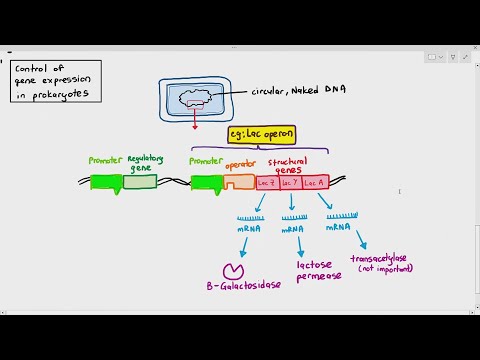
Lactose needs a permease to get into the cell and an enzyme to break it down. Write any two of these lac genes:
lacZ (gene for β-galactosidase) [1]
lacY (gene for lactose permease / β-galactoside permease) [1]
(lacA, the gene for β-galactoside transacetylase, is also accepted.)
Official mark scheme

 ▶ Topic lesson
A lesson on this topic · by OtterBioTutor. Tap the picture to open it on YouTube.
Solutions follow the official Cambridge mark schemes; marks are shown in grey. Videos are from other YouTube channels. Paper codes read component / series / year: M/J = May/June, O/N = October/November. Past-paper questions © UCLES, reproduced for classroom practice.