Q2 · 9701/41/O/N/25 Q6
Worked solution from the Analytical techniques Theory (Paper 4) booklet, Part 1 of 3.

Worked solution
(a)(i)
Rf value: distance moved by the component (spot) divided by distance moved by the solvent. [1]
Retention time: the time between injection and detection of a component. [1]
(a)(ii)
Thin-layer chromatography mobile phase: a solvent (polar or non-polar, or a named solvent). Gas/liquid chromatography stationary phase: a non-volatile (high boiling point) liquid. [1]
(b)
A is more soluble in the mobile phase (or A sticks less to the stationary phase) than B, so it travels further. [1]
(c)(i)
Count the different proton environments. Y is CH3COCH2CH2COCH3: the two CH3 groups are the same, and the two CH2 groups are the same. Z is CH3CH2COCOCH2CH3: the two ethyl groups are the same, giving CH3 and CH2.
Write 2 for Y and 2 for Z. [1]
(c)(ii)
Use the (n + 1) rule.
Y: the CH3 groups have no H on the neighbouring carbon, and the CH2CH2 protons only have each other (equivalent H), so both peaks are singlets. [1]
Z: CH3 next to CH2 gives a triplet; CH2 next to CH3 gives a quartet. [1]
Official mark scheme

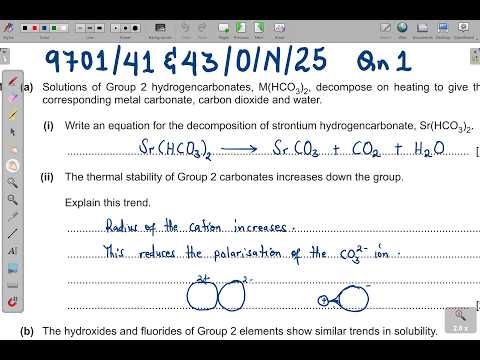 ▶ Whole paper
Video solution of the whole paper · by THE A* CHEMISTRY SOLDIER. Tap the picture to open it on YouTube.
Solutions follow the official Cambridge mark schemes; marks are shown in grey. Videos are from other YouTube channels. Paper codes read component / series / year: M/J = May/June, O/N = October/November. Past-paper questions © UCLES, reproduced for classroom practice.