Q50 · 9618/33/M/J/25 Q2
Worked solution from the Data Representation Paper 3 Advanced Theory booklet, Part 3 of 3.

Worked solution
(a)
Largest normalised positive mantissa is 0.1111111 (sign bit 0). Largest exponent is 01111111 = 127.
Mantissa 0 1 1 1 1 1 1 1, exponent 0 1 1 1 1 1 1 1 [1]
Denary: 127/128 × 2127 = 2127 − 2120 [1]
(b)
Change 3.59375 to binary: 11.10011, so 011.10011.
Two's complement: flip the bits and add 1 to get 100.01101, which is −4 + 0.25 + 0.125 + 0.03125. Working: number converted to binary and to its negative form [1]
Move the binary point 2 places left to give 1.0001101, so the exponent is 2 = 00000010. Working: exponent seen [1]
Mantissa: 1 0 0 0 1 1 0 1 [1]
Exponent: 0 0 0 0 0 0 1 0 [1]
Official mark scheme

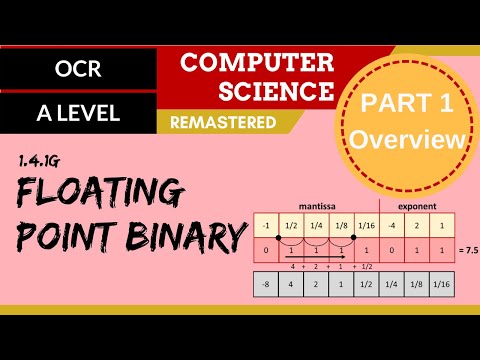 ▶ Topic lesson
A lesson on this topic · by Craig'n'Dave. Tap the picture to open it on YouTube.
Solutions follow the official Cambridge mark schemes; marks are shown in grey. Videos are from other YouTube channels. Paper codes read component / series / year: M/J = May/June, O/N = October/November. Past-paper questions © UCLES, reproduced for classroom practice.