Q23 · 0610/42/M/J/21 Q4
Worked solution from the Human influences on ecosystems Theory (Paper 4) booklet, Part 4 of 4.

Worked solution
(a)(i)
Any three reasons other than climate change:
Habitat destruction, for example deforestation. [1]
Over-collecting or removing too many of the plant species. [1]
Pollution (a named pollutant), introduced species, disease, or loss of pollinators. [1]
(a)(ii)
Any four of these:
More carbon dioxide is released by burning fossil fuels and by deforestation. [1]
More methane is released by farming (for example cattle) and landfill. [1]
The human population is increasing, so these emissions increase. [1]
This causes an enhanced greenhouse effect: greenhouse gases trap heat (infra-red radiation). [1]
(b)(i)
Any three of these:
To ensure genetic variation. [1]
The seeds represent many environments in which the plant can grow, so some can survive in a changing environment. [1]
There are not enough seeds in any one population, and there is more chance of cross-fertilisation, which increases the chance of successful germination. [1]
(b)(ii)
Write: mutations (a change in the base sequence of DNA, a genetic change). [1]
(b)(iii)
Any two of these:
At low temperatures there is low kinetic energy. [1]
So enzymes work slowly, with a low rate of effective collisions, and oxygen diffuses slowly. [1]
(c)(i)
Any three conditions: water, oxygen and a suitable (optimum) temperature.
Write: water [1]
Write: oxygen [1]
Write: suitable temperature [1]
(c)(ii)
Think about what roots do. Any four of these:
Large roots obtain resources from a larger or deeper area. [1]
They have a larger surface area and more root hair cells. [1]
So there is more uptake of water and mineral ions (salts), so the plants have enough resources to survive. [1]
Roots give anchorage, so the plant is not pulled out by grazing animals or wind; or there is reduced soil erosion. [1]
(c)(iii)
Write: the lag phase. [1]
Official mark scheme

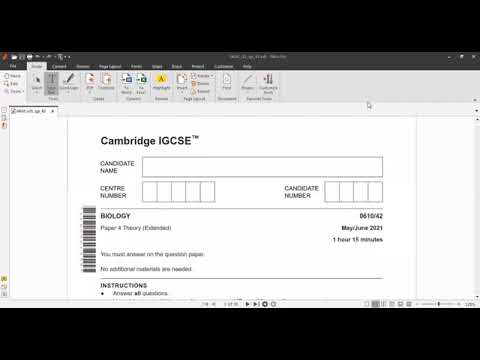 ▶ Whole paper
Video solution of the whole paper · by MaryAnneSchool. Tap the picture to open it on YouTube.
Solutions follow the official Cambridge mark schemes; marks are shown in grey. Videos are from other YouTube channels. Paper codes read component / series / year: M/J = May/June, O/N = October/November. Past-paper questions © UCLES, reproduced for classroom practice.