Q24 · 0620/43/O/N/25 Q3
Worked solution from the Metals Theory (Paper 4) booklet, Part 3 of 3.

Worked solution
(a)(i)
Write aluminium oxide. [1]
(a)(ii)
Aluminium oxide has a very high melting point, so it is dissolved in a molten solvent to lower the temperature. Write cryolite. [1]
(a)(iii)
Write carbon (graphite). [1]
(a)(iv)
Aluminium ions gain electrons at the negative electrode. Al3+ has charge 3+, so it takes 3 electrons.
Write Al3+ + 3e− → Al. Only Al3+ and 3e− on the left [1]
The equation is completely correct [1]
(b)(i)
Write that the aluminium has an unreactive coating of aluminium oxide. [1]
(b)(ii)
Balance the charges: 2 × (3+) = 3 × (2+) = 6+.
Write 2Al + 3Zn2+ → 2Al3+ + 3Zn. [1]
(b)(iii)
Zn2+: write +2. [1]
Zn (an element): write 0 (zero). [1]
(b)(iv)
Write: reduction is a decrease in oxidation number. [1]
(c)(i)
Write that ΔH is the enthalpy change (of reaction). [1]
(c)(ii)
A negative ΔH means energy is given out. Write that the reaction is exothermic. [1]
(d)
Write: amphoteric oxides react with acids and with bases to form a salt and water. [1]
(e)
Ga2O3 + NaOH → NaGaO2 + H2O. Balance: 2 Ga on the left needs 2 NaGaO2, which needs 2 NaOH.
Write 2NaOH + Ga2O3 → 2NaGaO2 + H2O. NaGaO2 on the right [1]
The equation is fully correct [1]
(f)
Gallium(III) is Ga3+. Bromide is Br− and sulfate is SO42−.
gallium(III) bromide: GaBr3 [1]
gallium(III) sulfate: 2 Ga3+ balance 3 SO42−, so write Ga2(SO4)3 [1]
Official mark scheme

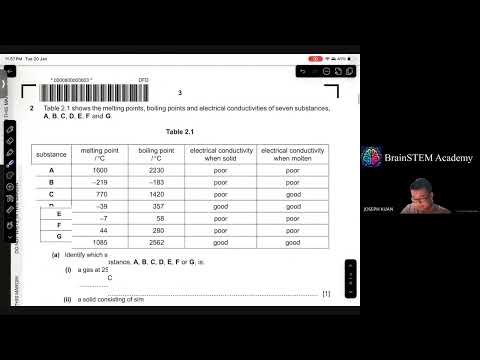 ▶ Whole paper
Video solution of the whole paper · by Teacher Joseph Kuan - IGCSE Chemistry Online Tutor. Tap the picture to open it on YouTube.
Solutions follow the official Cambridge mark schemes; marks are shown in grey. Videos are from other YouTube channels. Paper codes read component / series / year: M/J = May/June, O/N = October/November. Past-paper questions © UCLES, reproduced for classroom practice.