Q15 · 9700/42/O/N/21 Q1
Worked solution from the Homeostasis Theory (Paper 4) booklet, Part 1 of 2.

Worked solution
(a)
Use the diagram: A is a capillary endothelial cell, B is the capillary lumen, C is the thin line (the basement membrane), D is a podocyte, E is the space inside the Bowman's capsule (filtrate) and F is a capsule wall cell.
glomerular filtrate: write E. [1]
basement membrane: write C. [1]
podocyte cell: write D. [1]
capillary endothelial cell: write A. [1]
(b)
The question asks how each structure is adapted for ultrafiltration, so link structure to function. Any five points score.
The afferent arteriole is wider than the efferent arteriole. [1]
This causes high hydrostatic (blood) pressure in the glomerulus. [1]
The capillary endothelium has pores/fenestrations (gaps). [1]
The basement membrane acts as a filter. [1]
Podocytes have finger-like projections with slit pores between them. [1]
Extra points that also score: water, glucose, amino acids, urea and ions pass through, but blood cells and large proteins are held back; the glomerulus is a network of capillaries. (Only five marks are available.)
(c)(i)
Read Fig. 1.2: GFR rises from about 20 cm3 min−1 at 5 kPa to 100 cm3 min−1 at 10 kPa, stays at 100 between 10 and 20 kPa, then rises to about 190 at 25 kPa.
Write: as blood pressure increases the GFR increases, levels off, then increases again. [1]
Write: there is a plateau at 100 cm3 min−1 between 10 and 20 kPa. [1]
(c)(ii)
Write one of these: kidney damage/disease, dehydration, or low blood pressure/blood loss. [1]
Official mark scheme

 ▶ Topic lesson
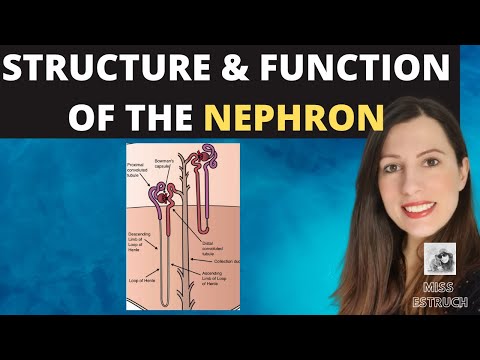
A lesson on this topic · by Miss Estruch Biology. Tap the picture to open it on YouTube.
Solutions follow the official Cambridge mark schemes; marks are shown in grey. Videos are from other YouTube channels. Paper codes read component / series / year: M/J = May/June, O/N = October/November. Past-paper questions © UCLES, reproduced for classroom practice.