Q17 · 5090/21/M/J/21 Q2
Worked solution from the Coordination and control Theory (Paper 2) booklet, Part 2 of 6.

Worked solution
(a)(i)
X points to the clear, rounded structure just behind the pupil and iris, at the front of the eye.
Write: lens. [1]
(a)(ii)
Give one structural feature and what it allows. Write one of these pairs.
Structural feature: the lens is transparent. [1]
Function: it lets light pass through and focus (refract) the light. [1]
(Another pair that scores the same two marks: the lens is flexible / elastic and can change shape, so it can focus objects (accommodation).)
(a)(iii)
Layer Y is the light-sensitive layer inside the choroid.
Write: retina. [1]
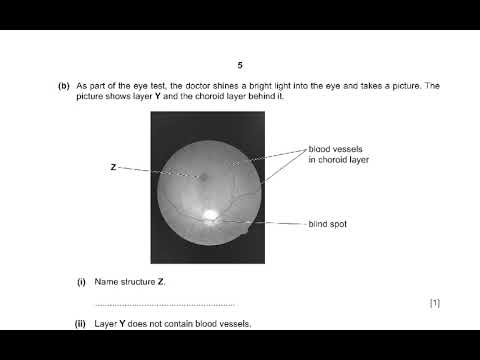
(b)(i)
Z points to the small spot at the centre of the retina picture, where vision is sharpest.
Write: macula (also accepted: yellow spot or fovea). [1]
(b)(ii)
The retina has no blood vessels of its own, so the choroid vessels must supply it and clear its waste. Write any four of these.
Blood brings oxygen for aerobic respiration. [1]
Blood brings glucose, amino acids, minerals or vitamins for energy / repair of cells. [1]
Blood takes away urea and carbon dioxide (waste). [1]
Substances move by diffusion from the capillaries into the retina. [1]
(Other points that score: blood brings white blood cells to fight infection; naming capillaries, veins or arteries in the right context.)
(c)
Follow the reflex arc in order. Write any four of these.
The retina (rods) detects the extra light intensity. [1]
An impulse is sent to the CNS / brain along the sensory neurone / optic nerve. [1]
The brain sends impulses along a motor neurone back to the iris muscles (effector). [1]
The circular muscles contract and the radial muscles relax, so the iris gets bigger and the pupil gets smaller. [1]
(Also accepted: calling the pathway a reflex arc.)
(d)(i)
Heterozygous means one dominant and one recessive allele, so each parent is Aa.
Parents: Aa × Aa [1]
Gametes: A and a from each parent. [1]
Children genotypes: AA, Aa, Aa, aa [1]
Phenotypes: AA and Aa produce melanin; aa does not produce melanin. [1]
(d)(ii)
Only aa does not produce melanin: 1 out of 4 children.
Write: 25% (or 1/4, 0.25, 1 in 4). [1]
Official mark scheme

 ▶ Whole paper
Video solution of the whole paper · by Dr Saira Biology. Tap the picture to open it on YouTube.
Solutions follow the official Cambridge mark schemes; marks are shown in grey. Videos are from other YouTube channels. Paper codes read component / series / year: M/J = May/June, O/N = October/November. Past-paper questions © UCLES, reproduced for classroom practice.