Q4 · 9706/22/M/J/20 Q4
Worked solution from the Cost and management accounting (AS Level) Theory (Paper 2) booklet, Part 2 of 2.

Worked solution
(a)
Explain three ways. Each is a main point plus a development (2 marks each). Write any three of these (the first three below earn the six marks):
Managers may help set the budgets for their own areas, which can increase motivation. [2]
If managers are not involved in setting budgets, motivation can fall, especially if targets look unachievable or unrealistic. [2]
Managers' efficiency can improve because they have clear objectives or targets. [2]
(Another credited point, no extra marks: Budgetary control can be restrictive, so managers may reject opportunities that would have been beneficial.)
(b)
Contribution per unit = selling price − variable costs
Selling price = $69 [1]
Direct materials 2 kg × $3.30 = $6.60; direct labour 5.2 hours × $8.30 = $43.16; other variable costs $2.24
Variable costs = $6.60 + $43.16 + $2.24 = $52 [1]
Contribution = $69 − $52 = $17 per unit [1]
(c)
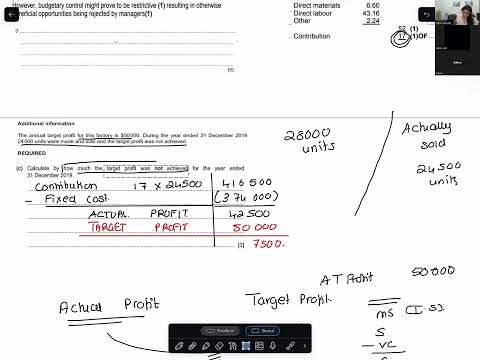
Profit = total contribution − fixed costs
Total contribution = 24 500 × $17 = $416 500 [1]
Actual profit = $416 500 − $374 000 = $42 500 [1]
Target profit not achieved by = $50 000 − $42 500 = $7 500 [1]
(d)
(i) Option A
Maximum capacity with overtime = 28 000 × 120% = 33 600 units. Demand = 24 500 × 140% = 34 300 units. So only 33 600 units can be made. [1]
Material discount of 5% = $6.60 × 5% = $0.33 a unit. Contribution on normal working = $17 − $3 + $0.33 = $14.33 [1]
Overtime is paid at 1.25 times, so extra labour cost = $43.16 × 25% = $10.79 a unit. Contribution on overtime units = $14.33 − $10.79 = $3.54 [1]
| Details | $ |
|---|---|
| Normal working: 28 000 × $14.33 | 401 240 [1] |
| Overtime: 5 600 × $3.54 | 19 824 |
| Total contribution | 421 064 [1] |
| Less fixed costs | (374 000) |
| Profit | 47 064 [1] |
(ii) Option B
Materials fall to 2 kg × $3 = $6.00, so contribution = $17 + $0.60 = $17.60 a unit.
| Fixed costs | $ |
|---|---|
| Current fixed costs | 374 000 |
| Extra depreciation (20% × $20 000) | 4 000 [1] |
| Interest (8% × $20 000) | 1 600 |
| Advertising ($5 000 × 12) | 60 000 [1] |
| Total fixed costs | 439 600 [1] |
Contribution: 28 000 × $17.60 = $492 800 [1]
Profit = $492 800 − $439 600 = $53 200 [1]
(e)
Advise: choose Option B, because it gives the higher profit and meets the target. [1]
Option B profit of $53 200 is $10 700 more than the 2019 profit of $42 500. [1]
It achieves the target profit of $50 000 and exceeds it by $3 200. [2]
Option A (profit $47 064) misses the target by $2 936. [1]
Option B avoids overtime, which may not suit the workforce and which may lower the quality of production. [2]
Maximum six marks for justification; the six marked above are enough.
(Points for Option A, which would score if you chose A instead: profit up by $4 564 on 2019; no permanent change in fixed costs, which helps if the extra demand does not last; the factory works at full capacity; it avoids a bank loan, which might be refused. Option B also makes full use of the factory.)
Official mark scheme

 ▶ Whole paper
Video solution of the whole paper · by IGCSE / AS LEVEL / A LEVEL MATHS AND ACCOUNTS. Tap the picture to open it on YouTube.
Solutions follow the official Cambridge mark schemes; marks are shown in grey. Videos are from other YouTube channels. Paper codes read component / series / year: M/J = May/June, O/N = October/November. Past-paper questions © UCLES, reproduced for classroom practice.