Q17 · 0610/43/O/N/20 Q5
Worked solution from the Reproduction Theory (Paper 4) booklet, Part 4 of 6.

Worked solution
(a)(i)
A single set of unpaired chromosomes is haploid. [1]
(a)(ii)
The sperm meets the egg in the oviduct. [1]
(a)(iii)
Describe the stages. Any four of these:
The sperm releases enzymes from the acrosome that digest the jelly coat of the egg. [1]
The nuclei fuse (fertilisation) to form a diploid zygote. [1]
The jelly coat hardens and the zygote moves along the oviduct towards the uterus. [1]
The zygote divides by mitosis (cell division) to form an embryo. [1]
(b)
Outline both. Any six of these:
Fertility drugs: FSH/LH are taken or injected early in the menstrual cycle. [1]
FSH stimulates follicles to develop and the ovaries to make oestrogen. [1]
LH stimulates ovulation. [1]
IVF: eggs and sperm are collected. [1]
Fertilisation happens outside the body in a dish, and the embryo develops in the dish. [1]
Embryos are inserted into the uterus, and progesterone is given to maintain the lining. [1]
Official mark scheme

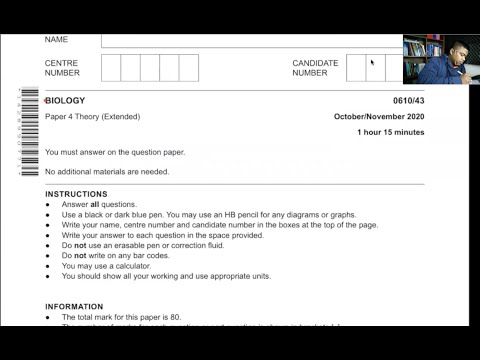 ▶ Starts at Q5 (43:44)
Starts at Q5 (43:44) · by Chemistry & Biology @ Belal Sir. Tap the picture to open it on YouTube.
Solutions follow the official Cambridge mark schemes; marks are shown in grey. Videos are from other YouTube channels. Paper codes read component / series / year: M/J = May/June, O/N = October/November. Past-paper questions © UCLES, reproduced for classroom practice.