Q16 · 9700/41/O/N/21 Q6
Worked solution from the Energy and respiration Theory (Paper 4) booklet, Part 2 of 2.

Worked solution
(a)
Molecule Y is released at the link reaction and in the Krebs cycle.
Write: carbon dioxide. [1]
(b)
In Fig. 6.1 reduced NAD is made when triose phosphate is converted to pyruvate.
Write: reduced NAD is made (NAD is reduced, so triose phosphate is dehydrogenated). [1]
(c)(i)
Add up all the ATP made, counting the ATP from reduced NAD and reduced FAD.
Glycolysis: net ATP = 4 − 2 = 2; reduced NAD = 2. Link reaction: reduced NAD = 2. So 4 reduced NAD × 3 = 12 ATP.
Krebs cycle: ATP = 2; reduced NAD = 6 × 3 = 18; reduced FAD = 2 × 2 = 4.
Total = 2 + 12 + 2 + 18 + 4 = 38 ATP [2]
(c)(ii)
Write any two reasons.
ATP (energy) is used to transport pyruvate or reduced NAD into the mitochondria. [1]
Some protons leak from the intermembrane space, or some energy is lost as heat, or glucose is not completely broken down / intermediates are used in other metabolic reactions, or reduced NAD is used for other reactions. (Write one of these.) [1]
(d)
NAD and FAD are coenzymes. [1]
They help dehydrogenase enzymes in glycolysis, the link reaction and the Krebs cycle. [1]
They carry hydrogen (as reduced NAD and reduced FAD) to the electron transport chain on the inner mitochondrial membrane (cristae). [1]
(e)
Rotenone stops electron transfer along the chain.
There is less energy released from the electron transfer, so fewer protons are pumped into the intermembrane space. [1]
The proton gradient is smaller, so less chemiosmosis: fewer protons move through ATP synthase. [1]
So less ATP is synthesised. [1]
Official mark scheme

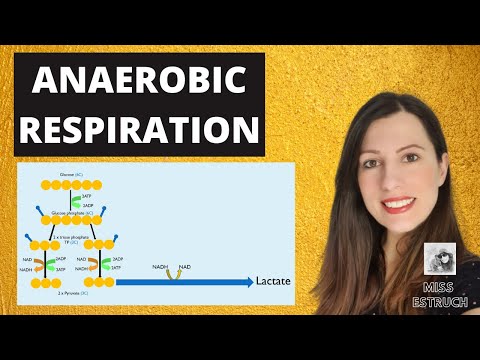 ▶ Topic lesson
A lesson on this topic · by Miss Estruch Biology. Tap the picture to open it on YouTube.
Solutions follow the official Cambridge mark schemes; marks are shown in grey. Videos are from other YouTube channels. Paper codes read component / series / year: M/J = May/June, O/N = October/November. Past-paper questions © UCLES, reproduced for classroom practice.