Q1 · 5090/22/M/J/21 Q1
Worked solution from the Transport in humans Theory (Paper 2) booklet, Part 1 of 4.

Worked solution
(a)
Tooth X is one of the pointed teeth at the side of the front of the jaw, next to the flat incisors.
Type of tooth: canine. [1]
Function: tearing / ripping / piercing food (chewing is not credited). [1]
(b)(i)
Find the lowest point of the honey line (solid).
It is the lowest at 5 and 10 minutes: pH 4.75. [1]
(b)(ii)
Read the time each line reaches pH 7.0: honey at 25 minutes, sugar at 40 minutes.
Difference = 40 − 25 = 15 [1]
Write the unit: minutes [1]
(c)(i)
Dental decay occurs below pH 5.5, so compare both lines against 5.5.
Sugar is more likely to cause decay, because the pH falls lower (3.5 compared with 4.75 for honey). [1]
The pH stays below 5.5 for a longer time (still 5.25 at 30 minutes, but honey has risen to 5.75 by 15 minutes). [1]
(c)(ii)
Write any two of these:
brushing teeth / using toothpaste, flossing / mouthwash, fluoride, avoiding sugar / using artificial sweetener, or using honey rather than sugar. Each correct way scores one mark: [2]
(c)(iii)
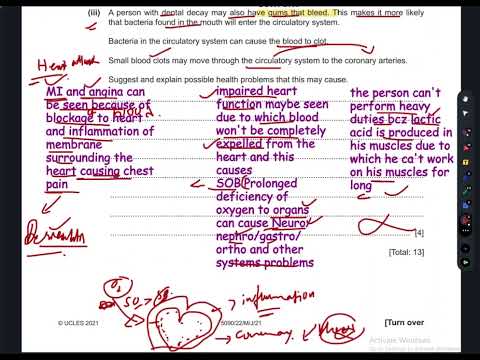
A clot in a coronary artery blocks the blood supply to the heart muscle itself. Write any four of the points below.
Possible problem: a heart attack / angina / breathlessness. [1]
The heart has less ability to contract / pump. [1]
Less blood reaches the body tissues, so less oxygen and glucose are delivered. [1]
Any one more point: less aerobic respiration / more anaerobic respiration, or lactic acid builds up, or the person has less ability to do physical activity / fatigue. [1]
Official mark scheme

 ▶ Whole paper
Video solution of the whole paper · by Captain AB. Tap the picture to open it on YouTube.
Solutions follow the official Cambridge mark schemes; marks are shown in grey. Videos are from other YouTube channels. Paper codes read component / series / year: M/J = May/June, O/N = October/November. Past-paper questions © UCLES, reproduced for classroom practice.